
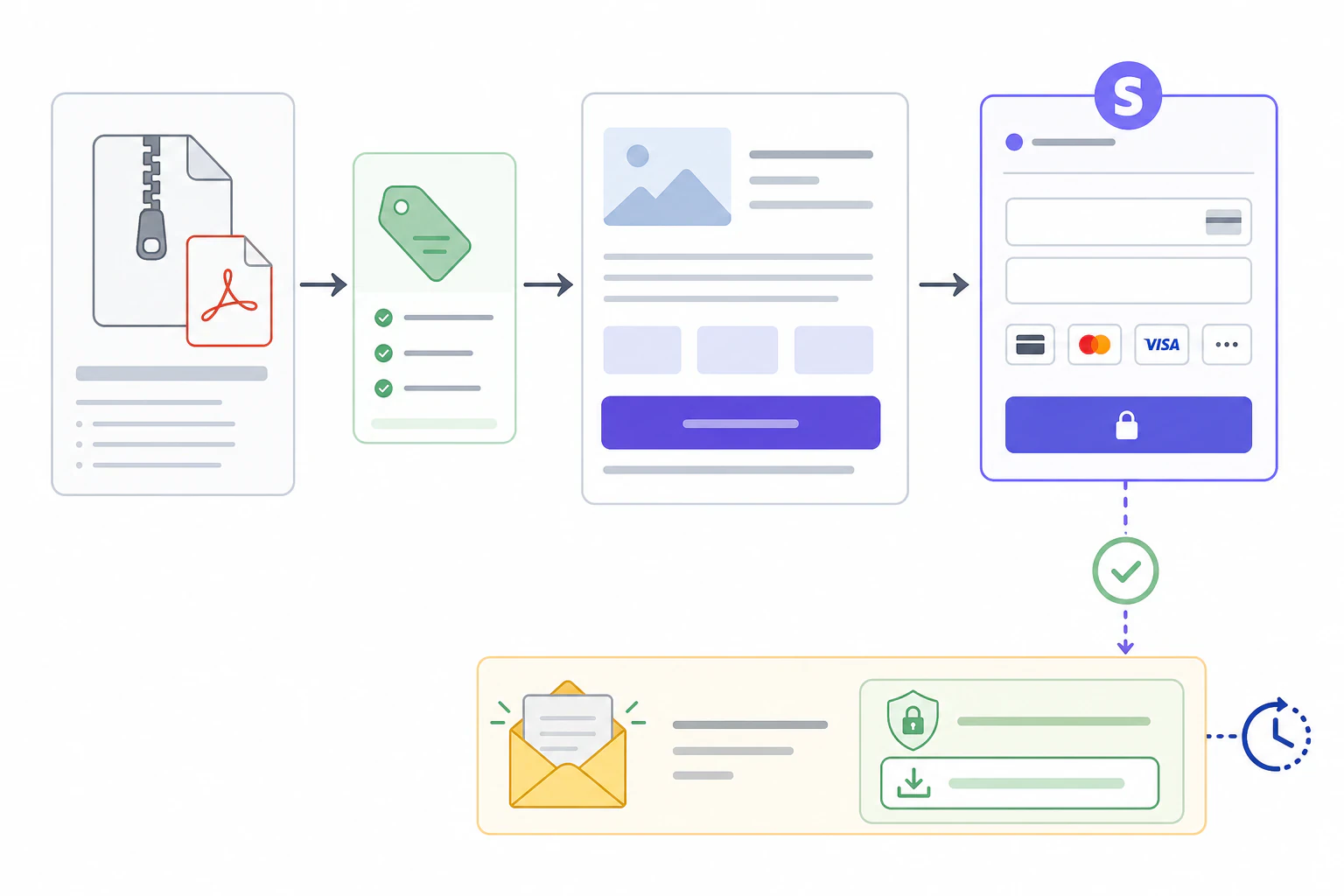
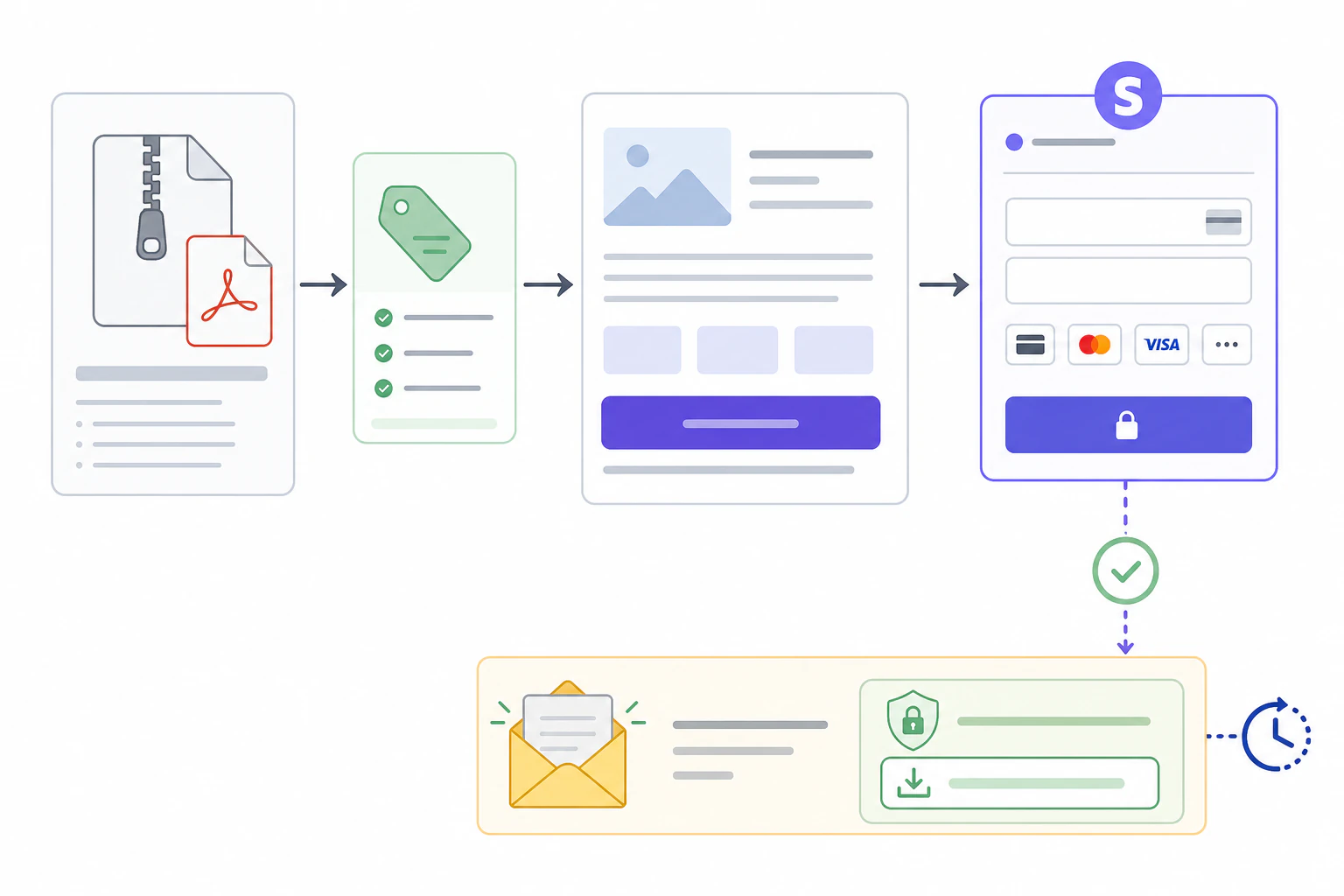
Drop the plan and the app, keep the file and the link.
Before: a Shopify plan at $29 a month, a separate downloads app just to attach the file to a product, and a cut of every sale on top. After: the same file, a Stripe checkout, and a link you can paste into an email or a bio, with nothing owed until something actually sells. Selling digital downloads never needed Shopify, and for one product or a small catalog it's usually the pricier way to do it. You've got three honest routes without it. A hosted checkout tool hands you a payment link in an afternoon. A marketplace like Gumroad or Etsy brings its own browsers but takes a cut and keeps the customer. Or you sell from your own site, where every dollar and every buyer's email stays yours, which is where a managed CMS like Devani fits.
Ebooks and PDF guides
The most common first product. A guide, a workbook, a recipe pack, a whitepaper. One file, priced once, sold forever, and the cheapest thing on earth to duplicate.
Templates and printables
Notion setups, spreadsheet models, resume layouts, wall art, planners, invitations. Usually a ZIP of a few files, and the biggest single category by volume on most marketplaces.
Presets and assets
Lightroom presets, LUTs, fonts, icon sets, stock photos, sample packs. Bundled, versioned, and sold to people who want your look without your labor.
Audio and music
Beats, loops, backing tracks, guided meditations, podcast intros. Delivered as WAV or MP3, often with a small license note about where the buyer can use it.
Software and license keys
Plugins, scripts, apps, and anything unlocked by a key. Here the delivery isn't a file so much as a code, and the tool you pick needs to generate and track those keys.
Video and mini-courses
A single tutorial download or a folder of lessons. Once you cross into drip-fed modules and student logins you've left "download" territory and want a course platform, but a zipped video pack sells fine as a plain file.
Three ways to take the money, and what each one costs you.
They trade off the same way every time: speed and built-in buyers on one end, ownership and margin on the other. Pick by what you're short on, traffic or time.
Hosted checkout tool
Fastest to a working link.
- ✓ A live payment link or embed in an afternoon, no site required
- ✓ Secure file delivery, receipts, and tax handled for you
- × A monthly fee or a per-sale cut, sometimes both
- × The checkout is theirs, so your branding only goes so far
Marketplace
Comes with buyers attached.
- ✓ Real built-in discovery: people already search Etsy and Gumroad
- ✓ Zero setup credibility, the trust is borrowed from the platform
- × A cut of every sale, and you rarely own the customer's email
- × Crowded shelves and constant price pressure from lookalikes
Your own site
Keeps every dollar and every email.
- ✓ No platform cut: you pay the card processor and nothing else
- ✓ The customer list, the domain, and the checkout are all yours to keep
- ✓ On a database-free CMS like Devani, no downloads plugin to buy or patch
- × No built-in audience: the traffic is on you to earn
A marketplace rents you an audience; your own site rents you nothing and keeps the list.
Getting a download live on your own site.
The hosted-tool and marketplace routes walk you through their own wizards. The own-site route is the one worth spelling out, because it's the one people assume is hard and mostly isn't.
- Get the file delivery-ready. Bundle multiple files into one ZIP so the buyer gets a single download. Compress oversized PDFs and export video at a sane bitrate, and check your tool's maximum file size before you upload a two-gigabyte pack.
- Connect Stripe. It's the processor nearly every route runs on, digital-goods friendly, and it settles straight to your bank. The standard US rate is 2.9% plus $0.30 per sale. No route on this page escapes a card fee, so treat that as the floor, not a surprise.
- Set the price. A flat price, a couple of tiers (personal vs commercial license), or pay-what-you-want with a minimum. Digital margins are near total, so the price is a positioning decision more than a cost one.
- Turn on secure delivery. Each buyer should get a unique link that expires after a set time or a set number of downloads, never a public file URL anyone can pass around. Good tools generate this automatically the moment payment clears.
- Point a custom domain at it. Buyers trust yourname.com over a random subdomain, conversions reflect it, and the domain is an asset you keep no matter what tool you outgrow.
- Handle the tax. Digital goods are taxable in most US states and carry VAT across the EU and UK from the very first sale, with no small-seller threshold in the EU. Wire in Stripe Tax so the right amount is calculated at checkout instead of reconciled by hand in April.
The fee math, side by side.
Two numbers decide the real cost of any route: the monthly fee, and the platform's cut of each sale on top of the card processor's fee. A "0% transaction fee" plan still pays Stripe or PayPal; a "free" plan usually makes it back on a per-sale percentage. Here's roughly where the common options land in USD.
| Route or tool | Monthly (USD) | Platform cut per sale | Note |
|---|---|---|---|
| Gumroad | Free to start | 10% on the free plan | Marketplace plus hosted checkout in one |
| Payhip | Free tier | A percentage on the free tier, lower on paid | Free custom domain even on the free plan |
| Whop | $0 | 2.7% + $0.30 | No monthly cost, built for creators |
| Sellfy | From $22 | None beyond the card fee | Handles digital and physical together |
| Checkout Page | From $24 | 0% | Hosted checkout, no marketplace |
| Podia | From $39 | 0% | Downloads, courses, and memberships in one |
| Shopify + downloads app | $29 to $39 | 2.9% + $0.30, more without Shopify Payments | The app sits on top of the plan you're already paying |
| Devani, your own site | Free managed tier, then flat plans | None beyond Stripe's 2.9% + $0.30 | Native store, no per-plugin fee |
Card fees apply on every line, marketplace or not, so the honest comparison is the monthly fee plus the platform's own cut layered above the processor. For a low volume of sales, a no-monthly option like Gumroad or Whop is cheapest even at a higher percentage. Once you're moving real volume, the percentage cuts start to hurt and a flat monthly or your own site wins. A website builder that takes no transaction fees of its own, leaving only the unavoidable card charge, is what ends that slow leak.
Getting the file to the buyer without handing it to everyone.
The uncomfortable truth first: anyone who buys a file can, in theory, share it, and no platform on the market changes that. Hard DRM on a PDF or a preset is mostly theater and tends to annoy honest customers more than it stops determined ones. What good delivery actually buys you is a clean paid flow and enough friction that casual leaking isn't effortless.
Three mechanisms do the real work. Expiring links, where the download URL dies after a day or a couple of clicks, so a link forwarded in a group chat is dead by the time it lands. Download caps, which limit how many times a single purchase can pull the file. And per-buyer identity: license keys for software that you can revoke, or a PDF quietly stamped with the buyer's email on each page, which won't stop copying but makes a leaker think twice about their name being on it. Pick a route that does at least the first two automatically. If you're selling software, keys are non-negotiable; if you're selling PDFs, stamping is a cheap, effective deterrent.
You can't lock a file down completely, so stop trying, and make the honest path the easy one instead.
Selling from a site you own, minus the maintenance tax.
The usual catch with "just use your own site" is the second half nobody mentions: on WordPress it means WooCommerce or Easy Digital Downloads, a stack of plugins, and the standing job of keeping them patched. That's the reason people reach for Shopify in the first place. It doesn't have to be the deal.
Devani is a fully managed, database-free CMS with the store built into the core, not bolted on as a paid add-on. Selling a digital download is a native product type: upload the file, set a one-time price or pay-what-you-want, and checkout runs through Stripe with secure delivery and Stripe Tax already wired in. There's no downloads plugin to license, nothing in a plugin stack to conflict or go stale, and no per-sale platform cut skimming your margin, just the card processor's cut like everywhere else. Because the whole site is plain files served from a CDN rather than queried from a database, the product page itself loads in well under a second and scores near 100 out of 100 on Lighthouse out of the box, which matters when a slow checkout is where digital sales quietly leak.
It's also about the fastest way to get the storefront standing. You can build the page with your own ChatGPT or Claude account connected over MCP, editing live inside the visual builder rather than alongside it, and have a real site up in ten to fifteen minutes, live in under a minute on the managed free tier with hosting, SSL, and backups handled for you. The honest limit: this is a light store, deliberately, good for a catalog of downloads, memberships, and merch, not a thousand-SKU warehouse with multi-location fulfillment. And it won't hand you an audience the way a marketplace does, so if discovery is what you're short on, start on Gumroad or Etsy and graduate to your own site once you've got buyers to bring with you. For the full picture of what the built-in store handles, Devani's ecommerce overview lays it out, and if you're specifically weighing the wider field, Shopify alternatives covers the rest of the options honestly.
Can I sell digital downloads without Shopify or any website at all?
Yes. A hosted checkout tool like Gumroad, Payhip, or Whop gives you a shareable payment link and delivers the file automatically, with no site to build. You paste that link into a bio, an email, a QR code, or a social post. It's the fastest route to a first sale, and you can always move to your own site later once the volume justifies keeping more of each sale.
What's the cheapest way to sell digital downloads?
It depends on volume. At a trickle of sales, a no-monthly tool that takes a percentage (Gumroad at 10%, Whop at 2.7% plus $0.30) costs you almost nothing until you sell. At steady volume, those percentages add up fast and a flat monthly plan or your own site wins. Selling from your own site on a managed CMS with a free tier means you pay only the Stripe card fee, which is usually the lowest total once you're past a handful of sales a month.
How do I deliver the file securely so it isn't just passed around?
Use a tool that generates a unique download link per buyer, set to expire after a short window or a capped number of downloads, instead of a public file URL. For software, issue license keys you can revoke. For PDFs, stamping each page with the buyer's email is a cheap deterrent. You can't make a file uncopyable, so aim for clean delivery and enough friction that casual sharing isn't effortless.
Do I have to charge tax or VAT on digital products?
Usually, yes. Most US states tax digital goods, and the EU and UK apply VAT on digital products from the first sale with no small-seller threshold in the EU, based on where the buyer is. The practical fix is to let Stripe Tax calculate and apply the right rate at checkout rather than tracking dozens of jurisdictions by hand. Most serious checkout tools integrate it.
Is Shopify ever the right call for digital downloads?
If you're already running a physical-product Shopify store and want to add a few downloads alongside it, the built-in Digital Downloads app is a reasonable bolt-on and not worth leaving over. But if downloads are the whole business, you're paying for a physical-commerce engine, plus an app, plus the plan, to do something a hosted checkout tool or your own site does for less. Buy the tool shaped like the job.
Sell the file, keep the margin.
If downloads are the business and you'd rather not hand a percentage to a platform you don't own, see what a native store on a managed CMS with a free tier looks like before you commit to a monthly plan.