
WordPress vs Devani: same ownership, opposite upkeep.
WordPress and Devani both give you a website you fully own. They split on who keeps it running. WordPress hands you every file and every plugin, then bolts the job of maintaining all of it onto that ownership. Devani gives you a site you fully own and can export any time, but engineers most of the upkeep out of the job instead of passing it to you.
WordPress gives you total control. You own the files, the database, the code, and every decision about how the site works, backed by a plugin ecosystem built over more than two decades. That control comes bundled with a job: someone has to keep all of it updated, secured, and running, for as long as the site exists.
Devani takes a different trade, and not the SaaS trade you might expect. It is a fully managed platform with a genuinely free tier and no per-site or plugin fees, with no plugin marketplace and no plugin-update treadmill to keep up with. PageSpeed scores tend to land fast by default rather than needing tuning, and you can connect your own ChatGPT or Claude account to make real edits to the site's content and layout natively, no plugin required. What you give up is WordPress's head start: a smaller, younger ecosystem with no plugin marketplace behind it yet. Neither trade is universally right, so here is the honest breakdown of where each one wins.
WordPress
Total control, backed by two decades of ecosystem.
- ✓ Over 60,000 free plugins for almost any niche need
- ✓ Migration tooling for every host and a deep freelancer market
- ✓ Self-hosted files and database you can move anywhere
- × A maintenance loop of core, theme, and plugin updates, forever
Devani
The same ownership, without the upkeep bolted on.
- ✓ Fast by default: database-free, static, ~100 Lighthouse out of the box
- ✓ No plugin marketplace, so no plugin stack to patch or secure
- ✓ Genuinely free to start, fully managed, no per-site or plugin fees
- × Younger, smaller ecosystem with fewer niche integrations
Where WordPress genuinely wins.
WordPress earns its market share honestly, and conceding that up front is the only fair way to start this comparison.
The plugin ecosystem
WordPress.org's directory holds more than 60,000 free plugins before you count anything premium. A booking calendar, a multi-warehouse inventory sync, a membership tier with drip-fed content: there is very likely already a plugin for exactly that, sometimes four or five competing ones. No other CMS, Devani included, has built anything close to that depth yet.
Migration tooling and familiarity
Your content is yours on both, exportable and never locked in. WordPress's real edge is everything built up around that: migration tooling for every host on earth, and a freelancer market where anyone you hire has already touched it before.
Community and documentation
The community behind all of it, the documentation, the forums, the large agency market, means most problems have already been solved by someone else once before you hit them. That depth of prior art is a genuine safety net.
Flexibility follows from both
Given enough plugins and enough patience, there is very little a website needs to do that WordPress cannot eventually be made to do. If that ceiling is the deciding factor for your site, WordPress is the honest pick, and the rest of this page will not change that.
Weighing options beyond just these two is worth doing as well. A roundup of WordPress alternatives covers more ground than a single head-to-head can.
Where Devani wins.
Devani's case starts with the job that comes bundled with WordPress ownership: keeping a plugin stack patched, forever.
Devani does not have one to keep patched, because there is no plugin marketplace in the first place, so there is nothing there to go stale. Updates run on your own schedule instead of a forced cadence, and every change gets an automatic snapshot with one-click rollback if something goes wrong. That maintenance-free shape does not cost a fortune either: Devani starts on a genuinely free tier, with simple flat plans as you grow and no plugin bills stacked on top.
That same database-free, file-based design is also why it is fast, and the numbers back it up, real and representative, not cherry-picked.
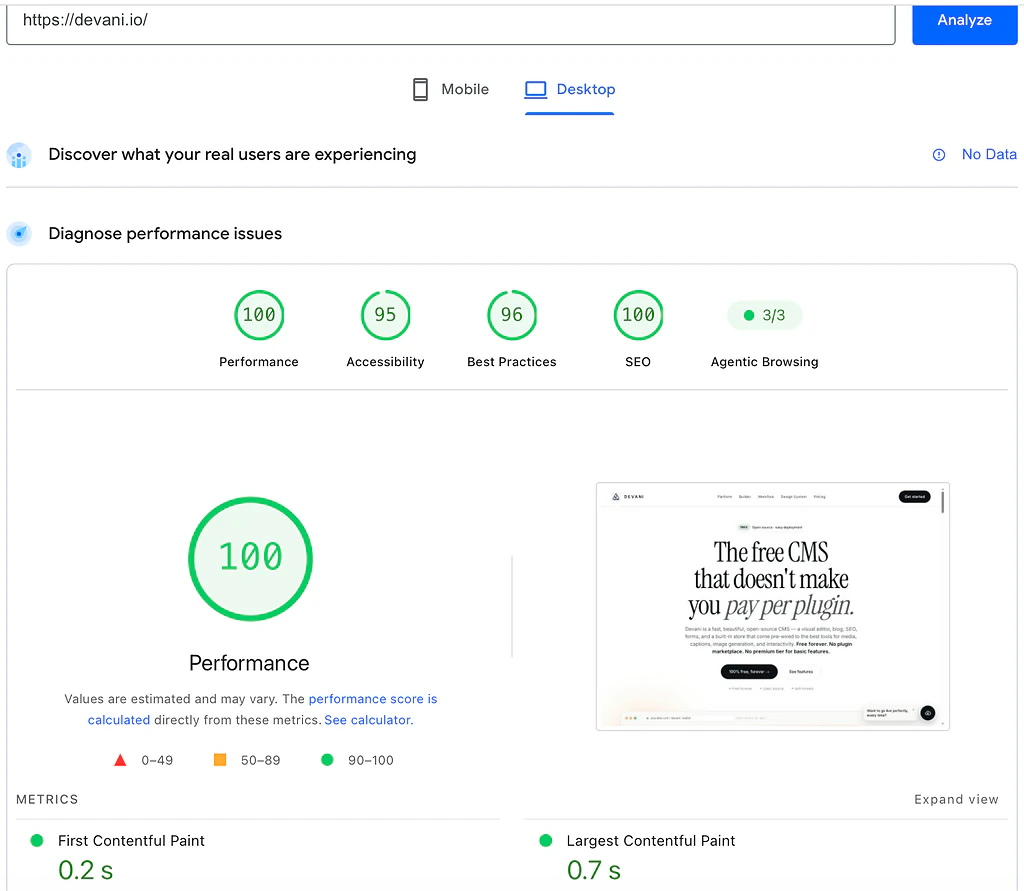
PageSpeed Insights desktop lab results for devani.io: 100 performance, 0.2s first contentful paint, 0.7s largest contentful paint, 100 SEO
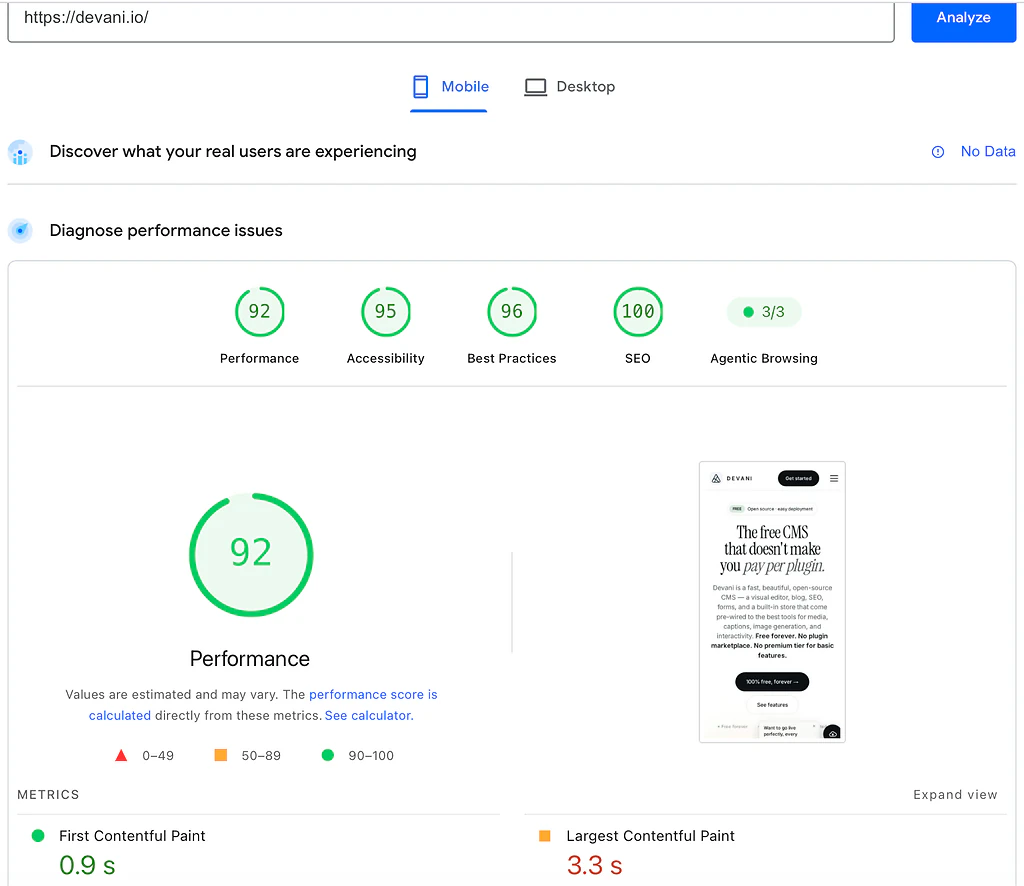
PageSpeed Insights mobile lab results for devani.io: 92 performance, 0.9s first contentful paint, 3.3s largest contentful paint
Desktop is a clean 100. Mobile drops to 92, an 8-point gap. Compare that against a typical WordPress site running its usual theme-and-plugin stack, tested cold, the way a real first-time visitor actually experiences it:
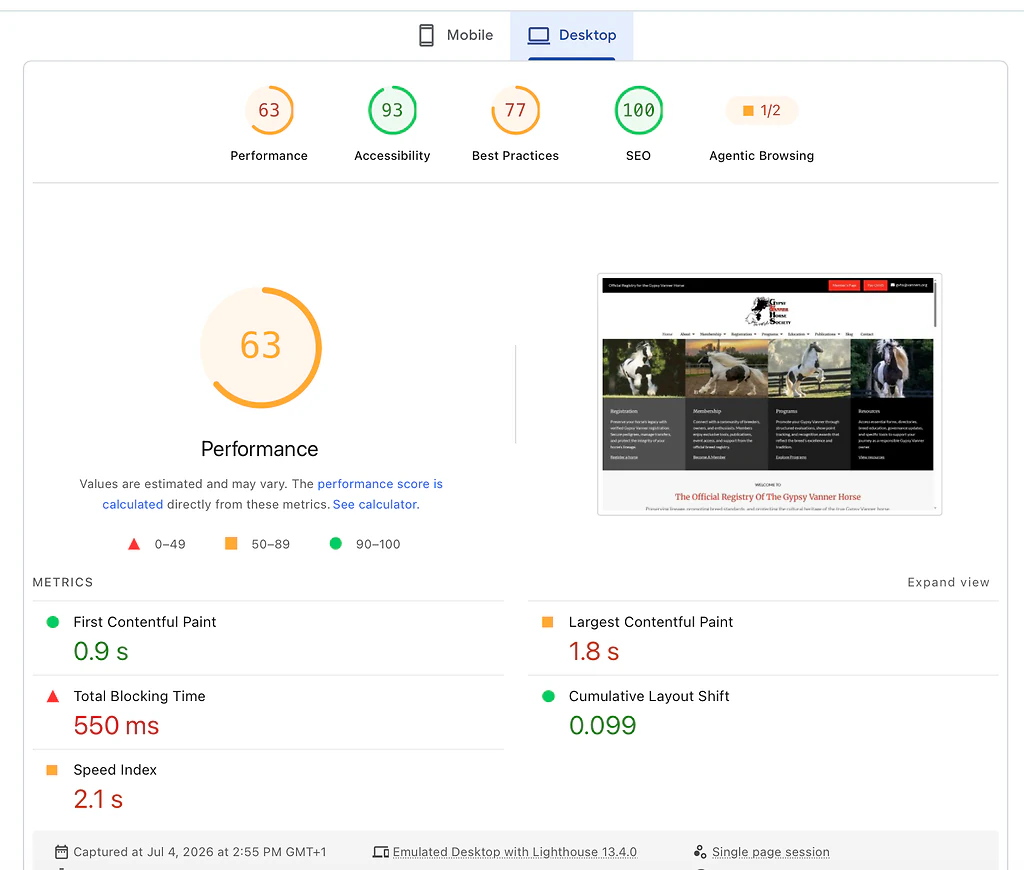
PageSpeed Insights desktop lab results for a typical WordPress site: 63 performance, 0.9s first contentful paint, 1.8s largest contentful paint
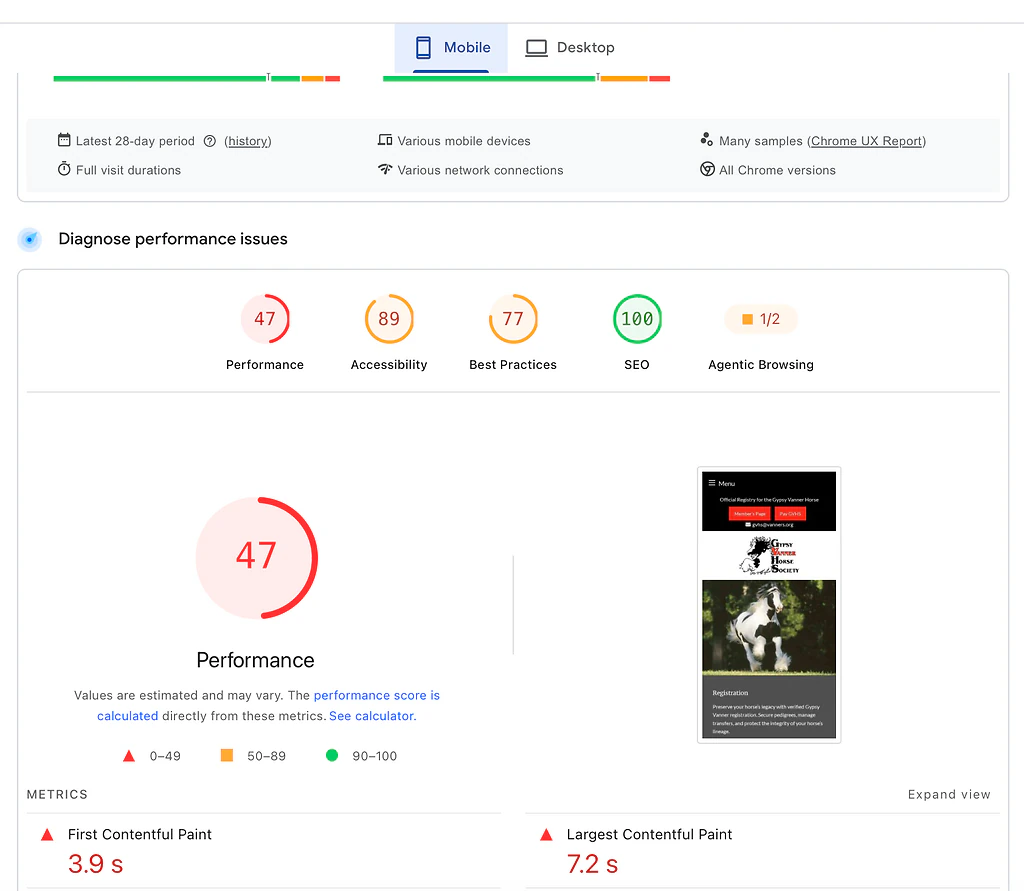
PageSpeed Insights mobile lab results for the same typical WordPress site: 47 performance, 3.9s first contentful paint, 7.2s largest contentful paint
A smaller desktop-to-mobile drop means the site holds up better on a slow connection. Devani falls 8 points, WordPress falls 16.
| Cold first load | Desktop | Mobile | Desktop-to-mobile drop |
|---|---|---|---|
| Typical WordPress site | 63 | 47 | 16 points |
| Devani | 100 | 92 | 8 points |
A lean WordPress build on strong hosting with caching tuned well can close some of that distance, but most real small-business sites never get there, because that tuning is ongoing work fighting the platform's defaults, not a setting you flip once. On Devani the fast numbers are the starting point, not a project. The same file-based shape carries into two other places WordPress usually needs a plugin for.
Security
Most real WordPress break-ins trace back to an outdated plugin or a theme with a known hole, not core itself. With no plugin stack there is nothing to go stale in the same way, and because updates are opt-in rather than forced, nothing patches itself out from under you unexpectedly.
SEO by default
Devani's markup is clean out of the box, with no dedicated SEO plugin required to get there. A typical WordPress build leans on something like Yoast or RankMath, configured correctly, to reach the same result.
Native AI editing
You connect your own ChatGPT or Claude account and it makes real edits to content and layout. As of this year that is no longer unique: WordPress.com shipped its own MCP integration, and the Vibe AI plugin brings something similar to self-hosted installs. What is different is that Devani's connection is native, one assistant reaching both content and layout because it was built into the CMS, not bolted onto a platform built two decades before this idea existed.
What each one actually costs.
"WordPress is free" is true of the software and misleading about everything around it.
A real small-business WordPress build, once you add hosting, a premium theme, a couple of plugins, and often a developer's time, tends to land between $30 and $100 a month. WordPress.com's managed plans are more straightforward on paper:
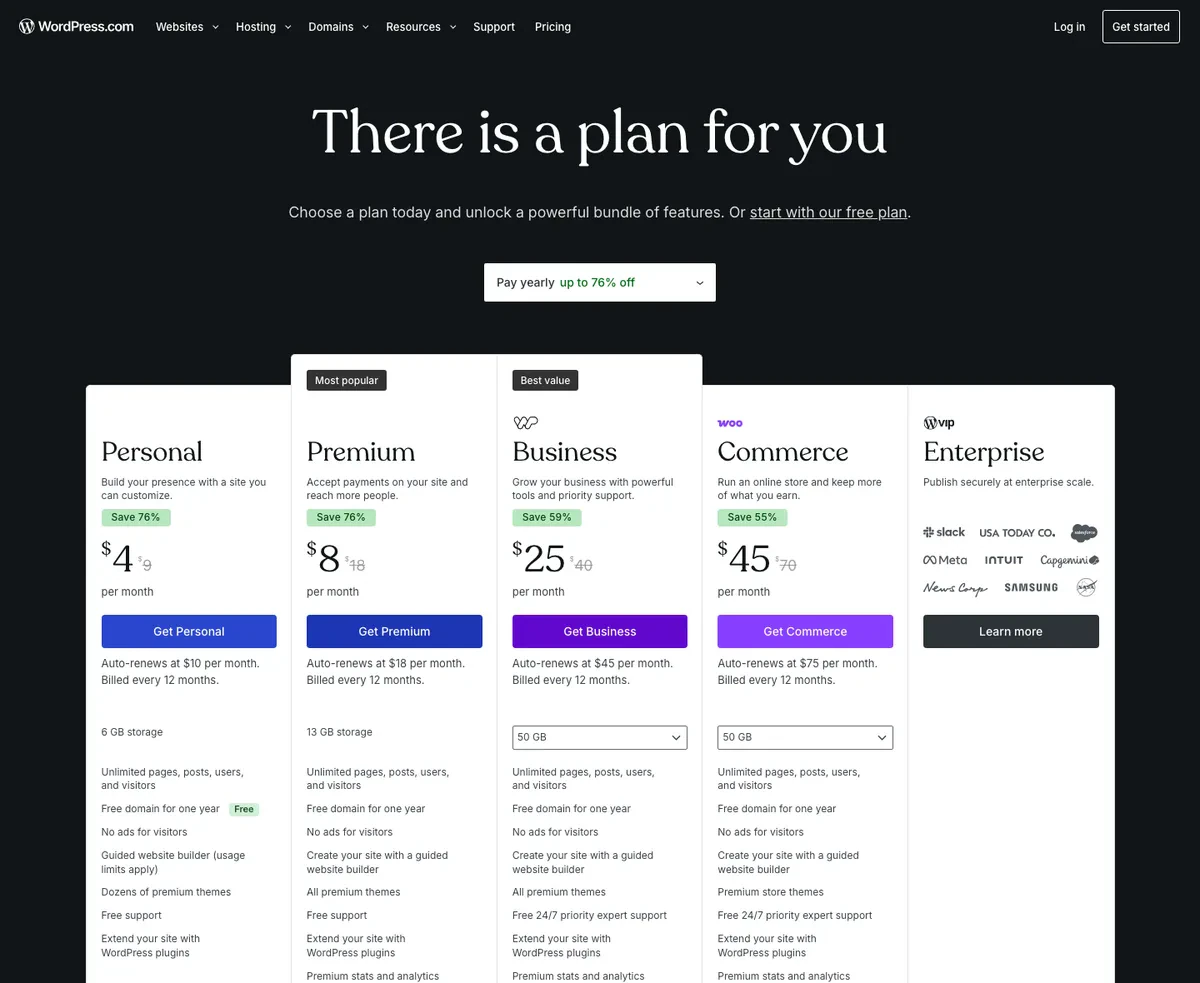
WordPress.com's pricing page in USD, showing the promotional annual rate next to the auto-renewal rate for each plan
| Option | Intro price | Renewal |
|---|---|---|
| WordPress.com Personal | $4/mo | $10/mo |
| WordPress.com Premium | $8/mo | $18/mo |
| WordPress.com Business | $25/mo | $45/mo |
| WordPress.com Commerce | $45/mo | $75/mo |
| Self-hosted WordPress build | $30 to $100/mo all in | |
| Devani | Free tier, then simple flat plans | |
That renewal jump after the first year is the part people tend to budget around wrong. Devani's honest answer is simpler: it starts free and stays flat. There is no license fee and no plugin bill to add to the total in the first place. The free managed tier is genuinely enough for many small-business sites, and paid plans are simple flat pricing as you grow, not a starter tier that quietly needs upgrading later. Hosting, SSL, the media CDN, backups, and updates are all included, so there is no separate SEO plugin, no separate backup plugin, and no separate security plugin, each carrying its own subscription.
Who should pick WordPress instead.
Devani is not the right fit for everyone, and pretending otherwise would undercut the honesty this whole page is built on.
- You need one specific, obscure plugin. A niche booking system tied to a particular industry, a complex membership structure, a shipping calculator built around one supplier's API. That plugin either already exists in WordPress's 60,000-plus directory, or it does not exist as a ready-made option anywhere yet.
- The surrounding infrastructure matters to you. Your content stays yours and exportable on both. But WordPress's migration tooling for every host on earth and its deep freelancer market are a legitimate reason to pick it, not a fallback position.
- You already have a developer or agency maintaining it. In that case the maintenance loop that makes WordPress a burden for a solo owner is somebody else's day job instead.
Devani is younger than WordPress by roughly two decades, and it shows in the places you would expect: a smaller ecosystem, no plugin marketplace to lean on, fewer of the highly specific integrations WordPress has accumulated over time. For how WordPress stacks up against the hosted builders too, not just against Devani, the WordPress vs Squarespace comparison covers that ground directly. If your site's requirements live inside that gap, WordPress is the more honest recommendation.
Is Devani really free?
Yes, there is a genuinely free managed tier, with no license fee and no per-plugin marketplace fees. Paid plans add custom domains, more sites, and agency tooling with simple flat pricing, and there are no plugin subscriptions stacked on top.
Can I migrate my WordPress site to Devani?
There is no one-click migrator, by design. You export your WordPress content, then have the connected AI account recreate the pages, posts, and metadata inside Devani. It is a guided rebuild rather than a lift-and-shift, which is one reason an existing developer-run WordPress install can be a fair reason to stay put.
Is WordPress or Devani faster?
Devani, out of the box. Its pages are static files with no database to query, so a cold first load lands around 100 desktop and 92 mobile against a typical WordPress site's 63 and 47. A carefully tuned WordPress build can narrow the gap, but that is ongoing work against the platform's defaults.
Do I still need SEO and security plugins on Devani?
No. Devani ships clean markup and per-page SEO controls without a Yoast-style plugin, and because there is no plugin stack, there is no plugin-update loop to secure. WordPress reaches the same place, but through configured plugins you have to maintain.
Keep the ownership, lose the upkeep.
For most small businesses the requirements are not that specific: a fast, secure site with no permanent maintenance assignment attached, editable in plain language by an AI account you already have.