
The honest split is store vs site.
If you already run a real store, a catalog with real depth, inventory across more than one location, shipping rules by weight and zone, a register that has to match what happens online, the answer is Shopify. It is built for that job in a way nothing on this page matches, us included. This is not a page telling you to move a working Shopify store. It is for the narrower, more common case: you want a fast, good-looking content and brand site with a handful of products attached, not a full storefront that runs the business. That is where Devani fits. If your situation is the first one, go start a Shopify trial and skip the rest of this.
Shopify
The store that runs the business.
- ✓ Best checkout in the industry, plus Shop Pay one-click repeat purchase
- ✓ Roughly 8,000 apps, POS, multi-channel, deep inventory and shipping
- × App stack and theme weight drag page speed down
- × Per-app fees, and a transaction fee unless you use Shopify Payments
Devani
A fast brand site with a few products attached.
- ✓ Genuinely free to start, no app stack to maintain, nothing metered per sale
- ✓ Fast by default, clean SEO markup, a light store with Stripe checkout
- ✓ Edit content and layout with your own connected AI, natively in the builder
- × Light store, not deep commerce: no multi-location inventory, no app marketplace
For a real store, nothing here is close.
These are genuine wins, and they hold whether or not Devani exists. If any of them describe how your business actually sells, Shopify is the platform and this page is not arguing otherwise.
Checkout that converts
Shopify's checkout is the best in the industry, full stop. Shop Pay's one-click repeat purchase is a real, measurable lift for any store with returning customers.
Roughly 8,000 apps
Subscriptions, loyalty, advanced search, review widgets, accounting sync. Nearly any commerce problem a merchant can name has an app for it.
POS and multi-channel
Shopify POS ties a physical register to the online store in real time, so a boutique isn't keeping two sets of books. Amazon, eBay, Instagram, TikTok and wholesale all plug into the same backend.
Inventory and shipping depth
Multiple warehouse locations, rate rules by carrier and zone, bulk order management a growing catalog actually needs. And dropshipping tooling that sits years ahead of anything bolted onto a lighter platform.
Set the catalog aside and the math flips.
Carrying Shopify's commerce depth costs something even when a site barely uses it: a marketplace of paid apps charging per feature, a per-transaction fee on top of card processing, an entire plugin-equivalent stack to maintain no matter how small the catalog. Devani skips all of that by design, a fully managed platform built for the lighter case and free to start.
Speed tells the same story. Devani is database-free: the whole site is plain files served statically from a CDN, so there is nothing to query and no app stack behind the page dragging it down. The numbers below are the default a plain site starts from, not a score you tune your way toward.
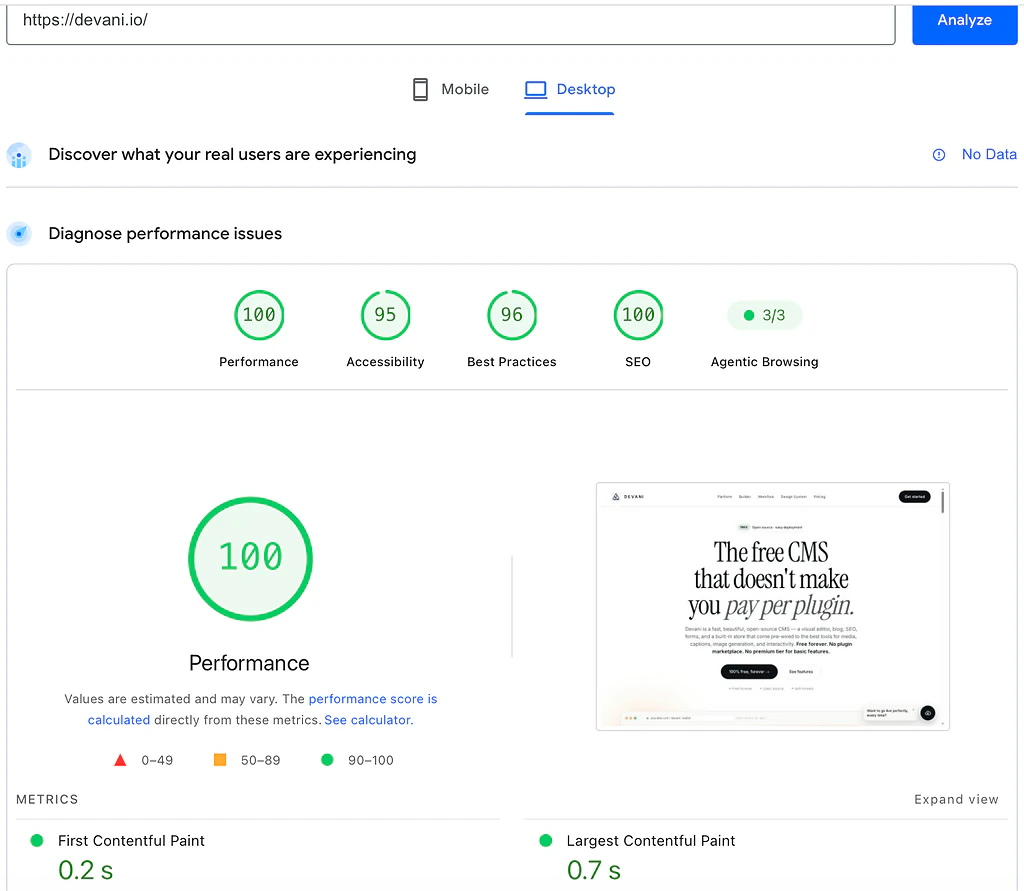
Devani desktop PageSpeed lab score: 100 performance, 100 SEO, 0.7s LCP
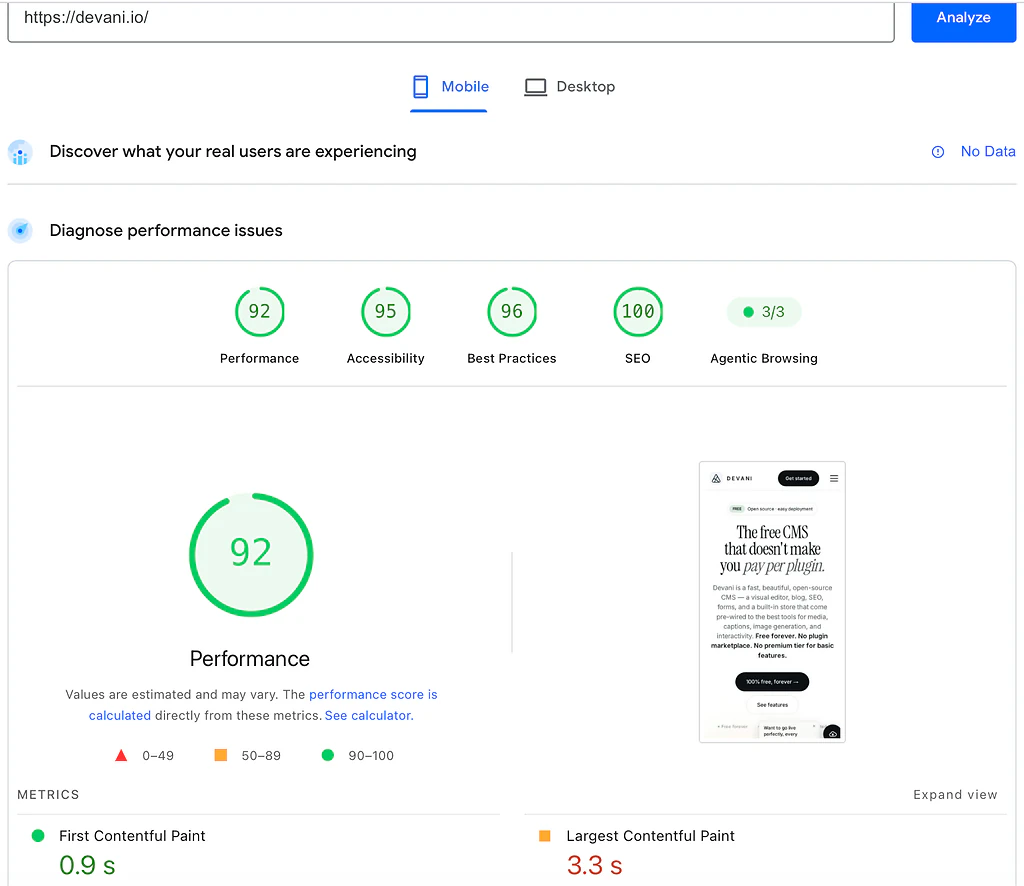
Devani mobile PageSpeed lab score: 92 performance, 3.3s LCP
Desktop-to-mobile is a throttled test, so a drop is normal for everyone. The tell is how small Devani's is: 100 to 92, an eight-point gap. Shopify speed is genuinely a range, not a fixed number. I have tested real stores landing anywhere from 45 to 92 on mobile PageSpeed depending on theme weight and how many apps got stacked onto the page. The store below is a typical small shop, not a cherry-picked bad example, and in cold first-load testing it scored 62 on desktop and 45 on mobile:
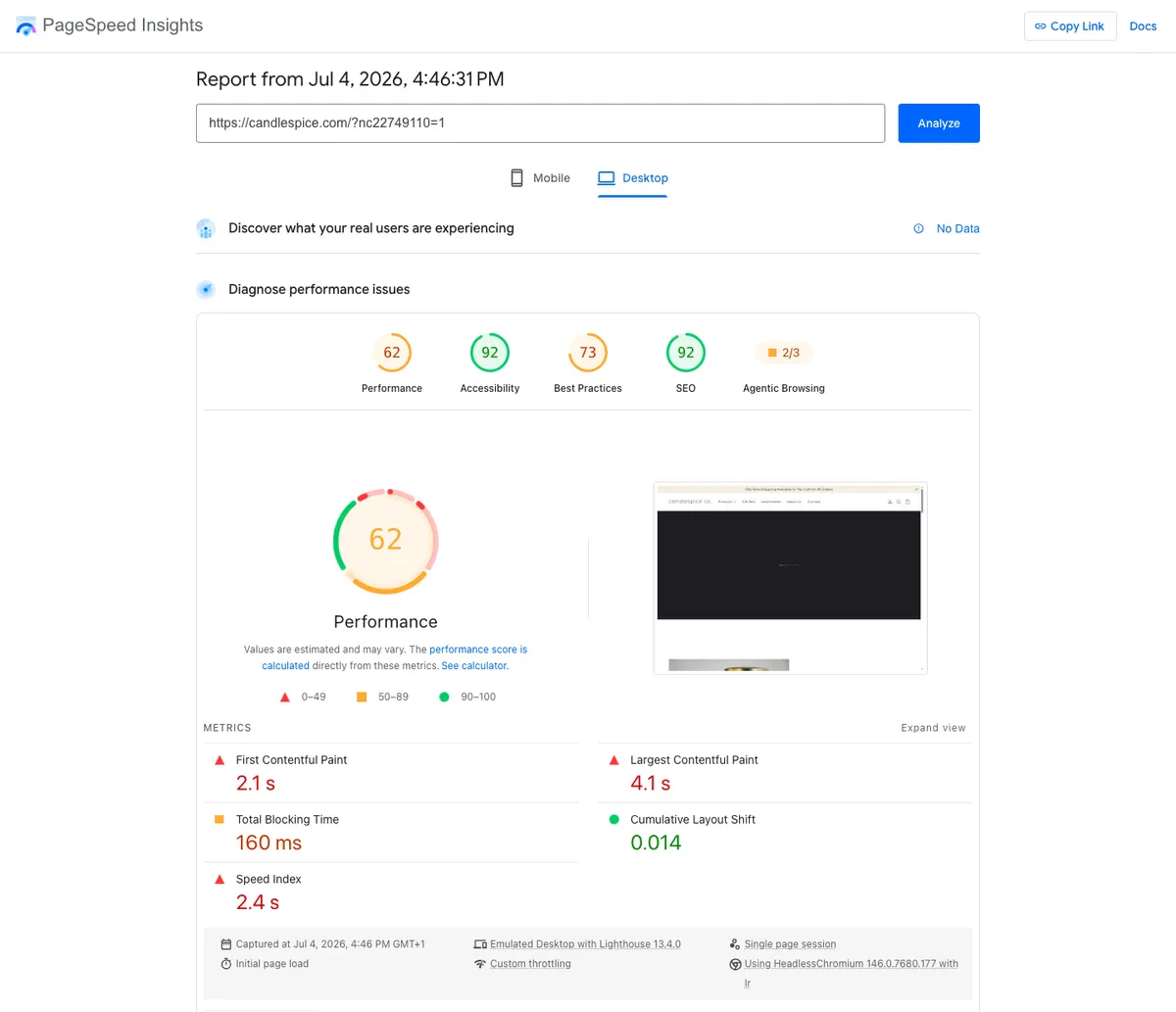
A typical small Shopify store's desktop PageSpeed lab score: 62 performance
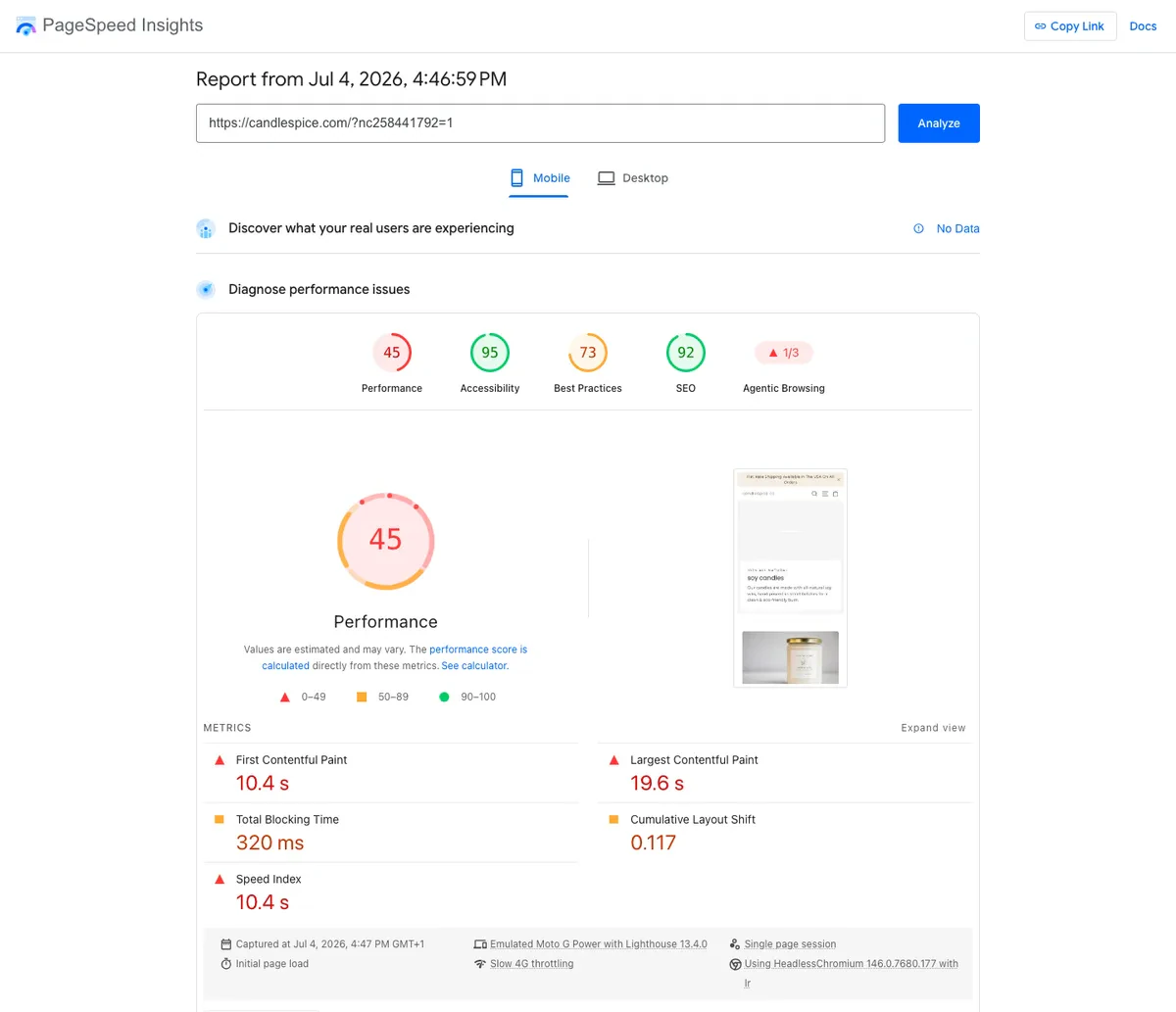
The same Shopify store's mobile PageSpeed lab score: 45 performance, 19.6s LCP
For a content-forward site with a few products attached, a service business selling a couple of add-on items, a maker with a dozen SKUs, a creator with a handful of digital downloads, most of what loads is content and marketing pages, not a product catalog. That is exactly what stays light here. The markup is SEO-clean out of the box, no separate SEO plugin required. And instead of hunting a settings menu or waiting on a developer for a copy change, you connect your own ChatGPT or Claude account and it makes the actual edit to your site's real content and layout, natively, because it is built into the CMS rather than bolted onto it through a separate plugin.
A fast, AI-native brand site with a small store attached, not a Shopify replacement.
Sticker price and real monthly cost.
Shopify's plan price is rarely the whole story. Use anything other than Shopify Payments as your processor and a transaction fee applies on top of standard card processing. It is avoidable by staying on Shopify Payments, but worth knowing before you line the numbers up.
| Plan | Monthly (USD) | Extra transaction fee off Shopify Payments |
|---|---|---|
| Starter | $5 (checkout link and a product page, not a full site) | Applies |
| Basic | $29 billed annually, $39 month to month | +2% |
| Grow | $79 to $105 | +1% |
| Advanced | $299 to $399 | +0.6% |
| Plus | from about $2,300 | Negotiated |
| Devani | Free to start; simple flat plans as you grow, everything included | None |

Shopify's pricing page in USD, showing Basic at 29 dollars, Grow at 79, Advanced at 299, and Plus from 2,300 per month billed yearly
Devani's cost is simpler because there is no per-app fee to weigh against the ladder. It starts free on a genuinely free managed tier, with simple flat plans as you grow and hosting, SSL, the CDN, backups, and updates all included.
Most real businesses belong on Shopify.
This is the part where that gets said plainly rather than buried.
If the catalog runs past a few dozen SKUs with real variants, if inventory needs tracking across more than one location, if the business sells through a physical register alongside the website, if dropshipping is the actual model, if there is a marketing team leaning on specific paid apps for subscriptions or loyalty or advanced email flows, Shopify is the right platform. Devani is not built for deep commerce. There is no complex shipping-rule engine, no multi-location inventory, no app marketplace to reach for when a store needs something specific, and it is a considerably younger platform with a much smaller ecosystem behind it. If any of that describes the store you are running, this page has done its job: it told you honestly that Shopify is the better fit. Worth a wider look too, a roundup of Shopify alternatives covers more ecommerce ground than just Devani, and Shopify vs Squarespace is the one to read if a hosted builder's own commerce tools are also on the table.
Is Shopify better than Devani?
For a real store, yes, and it is not close. Shopify's checkout, app ecosystem, POS and inventory tooling are built for deep commerce in a way Devani does not attempt. The comparison only tips toward Devani when the site is content-forward with a few products attached rather than a full storefront.
Can Devani replace a Shopify store?
Not a deep-commerce one. Devani has a light store with Stripe checkout, which suits a maker with a dozen SKUs or a service business selling add-ons. It has no multi-location inventory, no shipping-rule engine, and no app marketplace, so a store with real complexity should stay on Shopify.
Does Devani have a checkout?
Yes, a built-in light store with Stripe checkout, no separate ecommerce plugin to install. It is designed for a handful of products on an otherwise content-driven site, not for running a multi-channel catalog.
Why is my Shopify store slow?
Usually theme weight and stacked apps. Every app that injects a script or a widget adds to what the page has to load, and cold first-load PageSpeed scores drop accordingly. A lighter theme and fewer apps help, but on a content-forward site the app stack you are paying for is doing little, which is the case Devani is built for.
A fast brand site with a few products attached.
If that is the shape of what you need rather than a store with a website bolted on, that is the specific gap Devani was built to fill.