

Shopify, honestly, for the store it's actually built for.
Picture the moment a store owner clicks the Shopify trial button because it's the name everyone knows. If there's a real product business behind that click, a growing catalog, inventory to track, orders to ship, maybe a register at a market on weekends, it's the right instinct and the platform earns it. If what's behind it is a content-and-brand site with a dozen products riding along, that same click starts a monthly bill that keeps climbing. The pattern worth naming up front is that some Shopify stores thrive and some quietly bleed money on apps nobody remembered to cancel, and which one you get depends almost entirely on the kind of business behind the login. Where the light-store case applies, Devani, the free CMS this blog runs on, is the honest foil, and I'll get to exactly where.
Shopify isn't trying to be a general-purpose website builder that happens to sell things. It's a dedicated ecommerce platform first, and every part of it, the checkout, the app ecosystem, the reporting, is built around the assumption that selling is the whole point of the site. That focus is the source of both its real strengths and its real cost. Start with what an actual store needs, because that is exactly the ground Shopify was built to hold.
A checkout that converts
Shopify's checkout is consistently the highest-converting in ecommerce by most independent measures, and having built stores on both Shopify and general platforms with a store bolted on, the difference in completed-purchase rate is real, not marketing copy. Shop Pay, its one-tap accelerated checkout for returning customers, measurably reduces cart abandonment in a way I've watched play out on real analytics more than once.
Roughly 8,000 apps
The deepest ecommerce-specific integration library of any platform in this category. Need subscription billing, a loyalty program, an advanced product bundler, a specific freight carrier's live rate calculator. There's an app, usually several competing ones, built specifically for ecommerce rather than adapted from a general-purpose plugin. Depth in exactly the direction a store needs.
POS and one shared inventory
Shopify POS extends the same product and inventory data to a physical register. A business selling at a farmers market on weekends and online during the week, with one stock count that actually stays accurate, is something Shopify handles natively and most competitors handle only through awkward workarounds or not at all.
Real inventory and shipping depth
Multi-location stock tracking, discounted shipping labels through Shopify's carrier relationships, and tax handling built for actual order volume. This is the kind of infrastructure a growing store needs and most general website builders were never built to provide. It goes well past a bolt-on store's basics.
Multichannel selling
The same inventory can list on the online store, social platforms, and major marketplaces, with orders flowing back into one place. Dropshipping operations and any store planning to sell across channels from one back end get genuine, hard-to-replicate value here. It's also the default platform the dropshipping world builds on, largely because of how easily the app ecosystem connects to external suppliers.
Infrastructure handled, plus Magic
Hosting, SSL, PCI compliance, and platform updates are all handled on Shopify's end. Its own AI features, bundled as Shopify Magic with an assistant called Sidekick, are built in at no extra cost across plans, drafting product descriptions and answering basic store questions without a separate tool.
Give Shopify its due on all of that, because it earned the category leader position, not just the name recognition. Checkout conversion, app depth, POS and multichannel, and real inventory and shipping tooling are genuinely best-in-class, and for anyone building a real store, I'd recommend it without much hesitation. The honest other side is the cost structure, which catches more people off guard than almost anything else in ecommerce.
The bill runs deeper than the plan price suggests.
None of these are a knock on the platform doing its job. They're the layers a store owner budgeting around the sticker price tends to discover one at a time, usually after signing up, and they're worth knowing going in.
Monthly cost is the first layer, and it's higher than it looks on the pricing page once you account for the second: the transaction fee. If a store doesn't use Shopify Payments, Shopify's own processor, it adds a percentage on top of standard card processing, roughly 2 percent on the Basic tier, 1 percent on Grow, and 0.6 percent on Advanced. That fee disappears entirely with Shopify Payments, but Shopify Payments isn't available in every country and isn't the right processor for every business's existing merchant relationships, so a meaningful number of stores end up paying it.
App-cost stacking is the layer that quietly does the most damage to a store's actual monthly total. The base plan price is not the real total once a store adds paid apps for reviews, upsells, subscriptions, or a specific integration a competitor's plugin market would have covered for free. I've audited more than one client's Shopify bill and found three or four small app subscriptions running $10 to $50 a month each, forgotten after the trial period ended, adding up to more than the plan itself. Theme cost is a smaller but real line item people forget too: Shopify's theme store is narrower and pricier than a general builder's template library, and while the free themes are perfectly usable, a lot of stores end up buying a premium theme for one specific layout feature, typically $100 to $500 as a one-time cost.
Speed is the last layer, and it's a wide range rather than a fixed number, driven almost entirely by theme choice and how many apps a store is running. Across three real Shopify stores tested cold for this review, mobile PageSpeed scores ranged from 45 up to 92, a genuinely enormous spread for the same platform. A heavier theme stacked with apps drags a store down fast; a lean build on a fast theme holds up well.
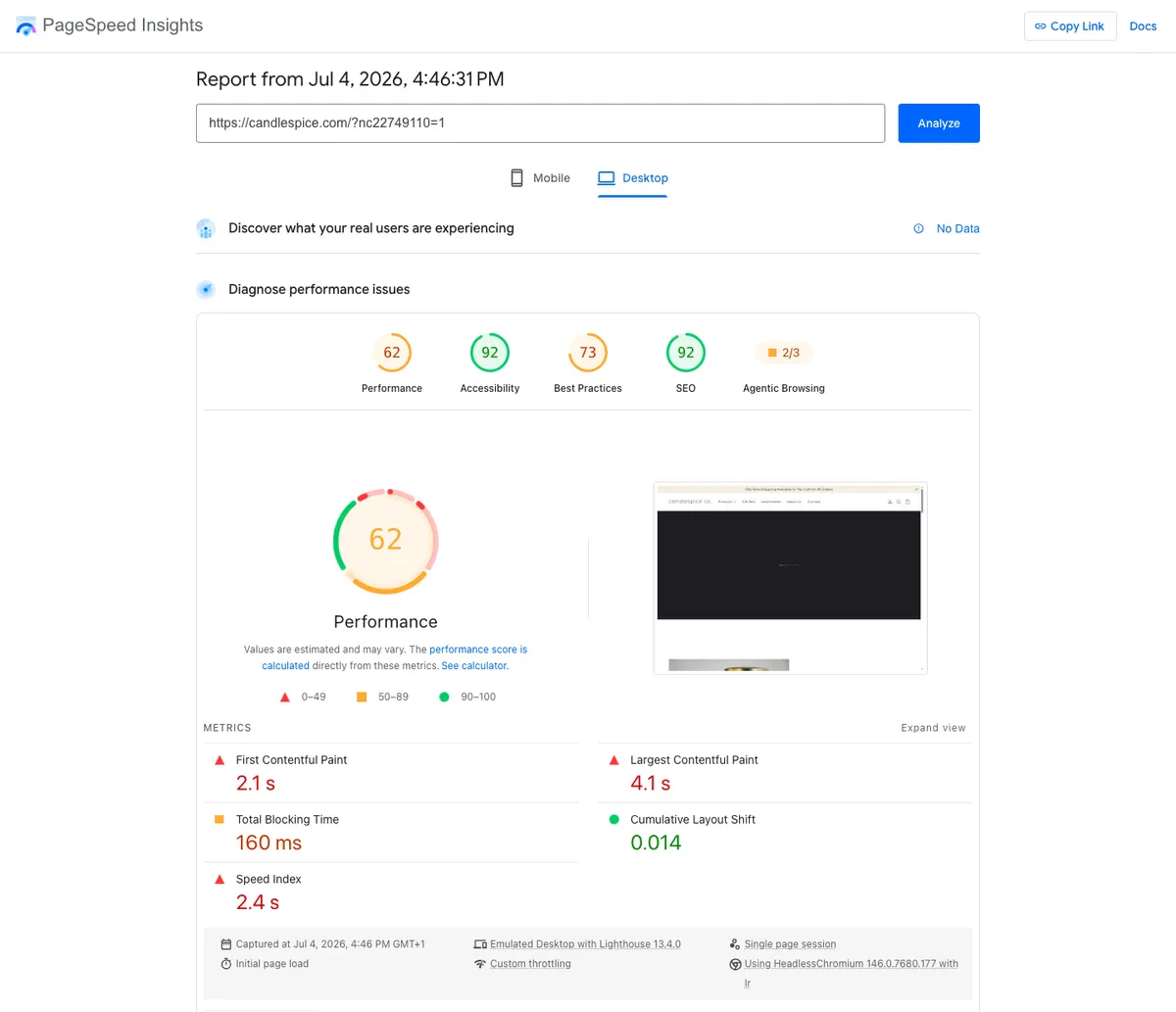
PageSpeed Insights desktop lab results for a real small Shopify store tested cold: 62 performance, 92 SEO, 2.1 second first contentful paint, 4.1 second largest contentful paint
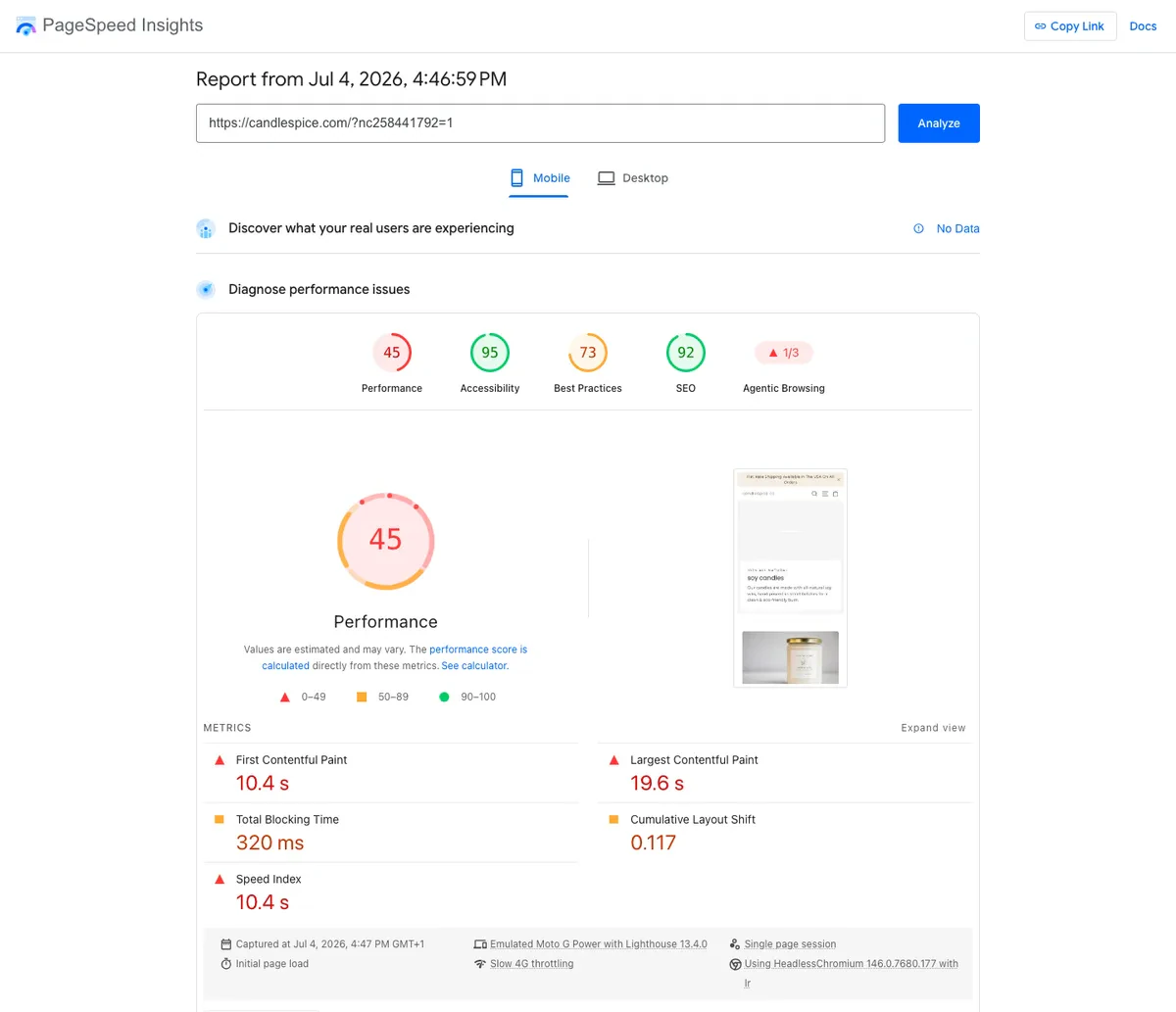
PageSpeed Insights mobile lab results for the same Shopify store: 45 performance, 10.4 second first contentful paint, 19.6 second largest contentful paint
The store above, a typical small catalog selling a modest physical product line, landed at 62 desktop and 45 mobile, on the lower end of the range tested but not the worst case on the platform. That's the honest number for a real, unremarkable store rather than a stripped showcase build, and it makes the point better than an average would: on Shopify, speed is something you actively manage through theme and app choices, not something the platform hands you by default.
The transaction fee, the app stack, and the speed you have to manage yourself are all the price of a commerce engine you may not need.
Every one of those cost layers is a commerce-platform problem, and it only applies to a business actually running commerce at the depth Shopify is built for. That is the exact seam where a lighter architecture answers a different question, so here's the honest side-by-side for the light-store lane, and nothing beyond it.
Shopify
A real commerce engine, priced like one.
- ✓ Highest-converting checkout and the deepest ecommerce app ecosystem in the category
- ✓ POS, multichannel, and real multi-location inventory and shipping tooling
- × Plan price plus a possible transaction fee plus a stacking pile of app subscriptions
- × Speed depends entirely on theme and app discipline, not on any default
Devani
A light store, without the commerce overhead.
- ✓ Light store with Stripe checkout and no transaction-fee stacking on top of a plan
- ✓ Fast by default: pages are stored as files and served statically from a CDN, not queried from a database on every request
- ✓ Connect your own ChatGPT or Claude account natively, inside the builder, to change content and layout
- × A light store only, not deep commerce: no POS, no multichannel, no 8,000-app ecosystem
Said plainly and kept in its own lane: for a business whose site is mostly content and brand with a handful of products riding along, Devani is worth knowing about, and I wouldn't call it a Shopify replacement because it isn't trying to be one. There's no transaction fee stacking on top of a plan because there's no commerce engine attempting to match Shopify's depth in the first place. The site loads fast by default because pages are stored as files rather than pulled from a database on every request. Editing happens by connecting your own ChatGPT or Claude account, natively and inside the builder, and asking it to change the content and layout directly, nothing purchased and installed first. A site can be built with that AI in ten to fifteen minutes, and on Devani's managed free tier a subdomain is live in under a minute. For the fuller field beyond that light-store lane, Shopify alternatives covers the rest of the category. For a real store with real inventory and volume, none of that changes the answer: Shopify's depth is the right tool for that job, full stop.
Worth showing rather than just claiming it, here's the same kind of lab test run on devani.io itself, a separate platform from Shopify entirely, not a comparable store but the same honest measurement.
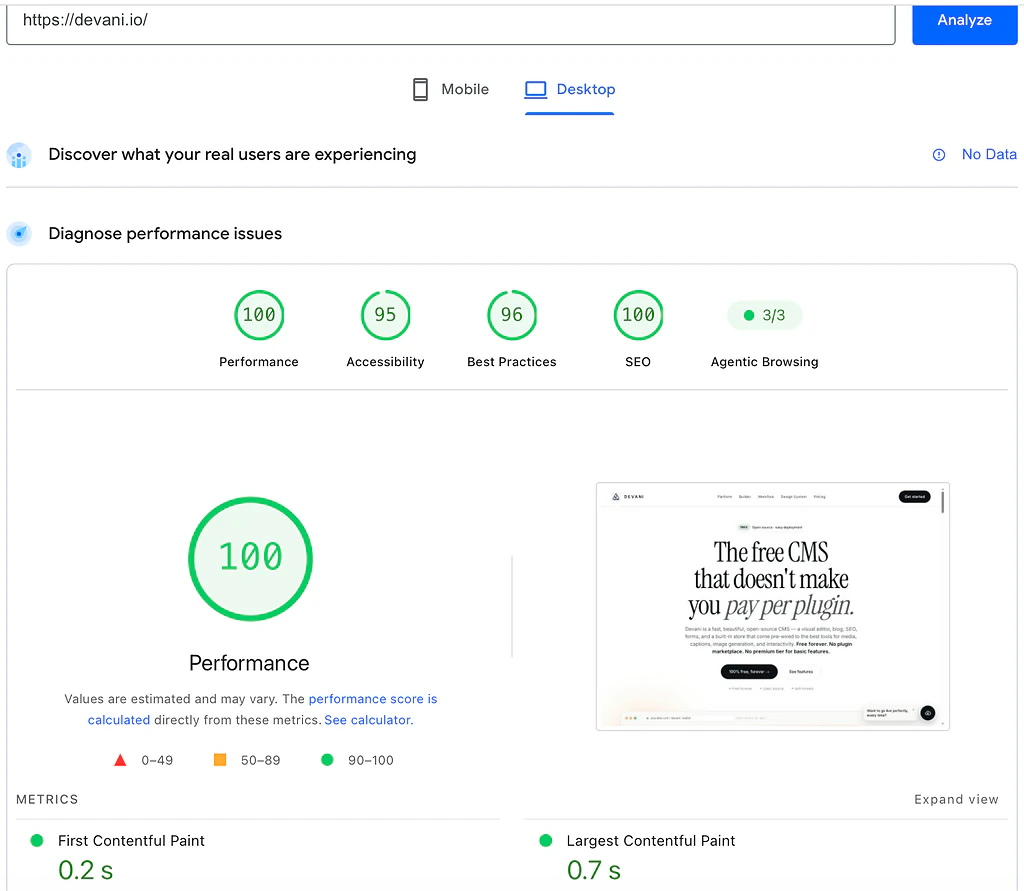
PageSpeed Insights desktop lab results for devani.io: 100 performance, 0.2 second first contentful paint, 0.7 second largest contentful paint
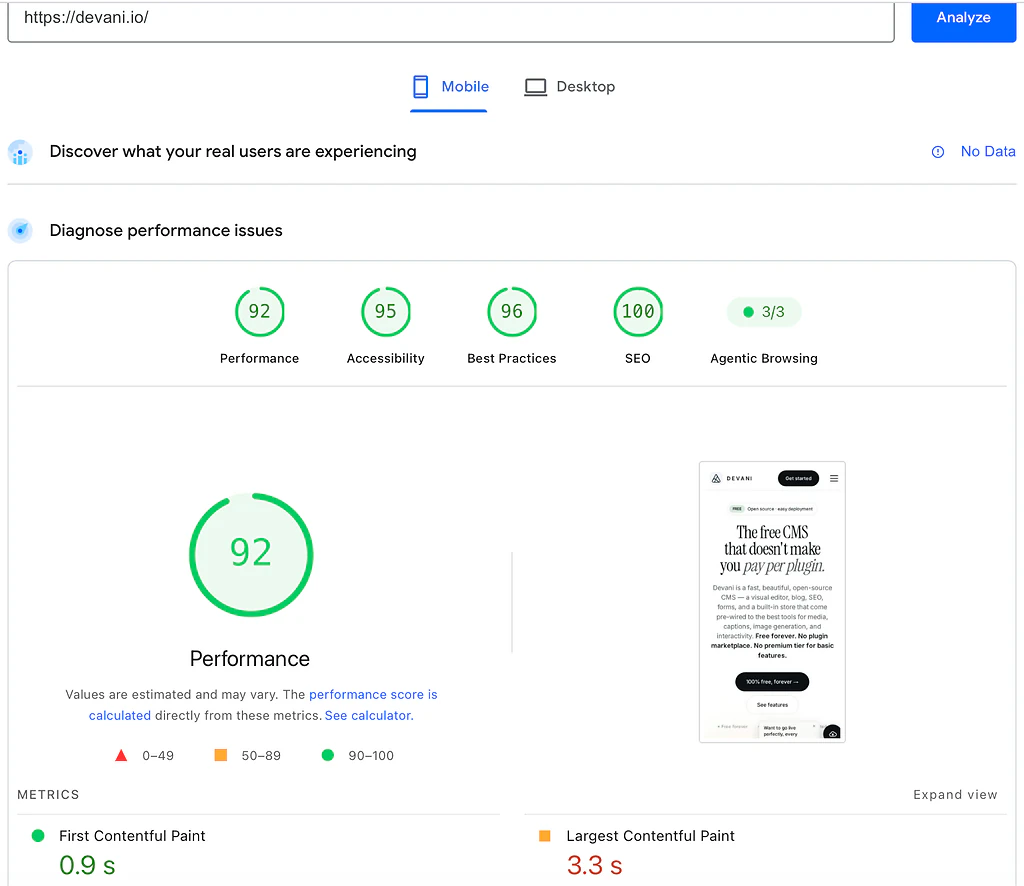
PageSpeed Insights mobile lab results for devani.io: 92 performance, 0.9 second first contentful paint, 3.3 second largest contentful paint
That gap next to the 62 and 45 shown earlier isn't a knock on Shopify's platform. A heavily app-driven commerce engine has more work to do on every page load than a database-free content site ever will. It's just the honest number, shown rather than asserted, for the light-store lane this section is actually about.
Is Shopify good for beginners?
More than its reputation suggests and less than its marketing implies, both at once. The admin is genuinely well organized: product setup, order management, and basic customization through the theme editor are all approachable for someone with no development background, and the onboarding flow does a reasonable job of getting a first product listed and a payment method connected within an afternoon. Sidekick, the built-in Shopify Magic assistant, helps with the parts beginners tend to get stuck on without requiring a separate tool.
Where the learning curve shows up is everything past the basics. Configuring shipping zones correctly, understanding how apps interact, and reading the fee structure closely enough to predict a monthly bill all take real time to get right. I've watched more than one first-time owner get the storefront looking good in a weekend and then spend the next month discovering how shipping rules, tax settings, and a stacked handful of apps were quietly working against each other. None of that is unique to Shopify, most ecommerce platforms have the same hidden depth, but "easy to start" and "easy to run well" are two different claims. Support tracks the same shape: for straightforward account and billing questions, response times are reasonable and the documentation is extensive, but for a complex multi-part issue, an app conflict interacting with a theme customization interacting with a shipping rule, a fast definitive answer is less consistent, and I've had client tickets take longer than the underlying problem probably warranted.
Shopify pricing, tier by tier
Shopify runs five plans. Layer the transaction fee on top of whichever tier applies if Shopify Payments isn't in use, add a couple of useful paid apps, and the realistic monthly cost for a genuinely active small store tends to land noticeably above the plan's sticker price. That's not a hidden trick, it's just not the number most people budget around going in.
| Plan | Monthly price | Best for |
|---|---|---|
| Starter | $5 | A link-in-bio and social-selling tool, not a full storefront |
| Basic | $29 annual / $39 monthly | A first real store getting off the ground |
| Grow | $79 annual / $105 monthly | Where most established small stores land |
| Advanced | $299 annual / $399 monthly | Growing stores needing detailed reporting and lower processing rates |
| Plus | from around $2,300, custom | Enterprise, high-volume merchants with dedicated support needs |
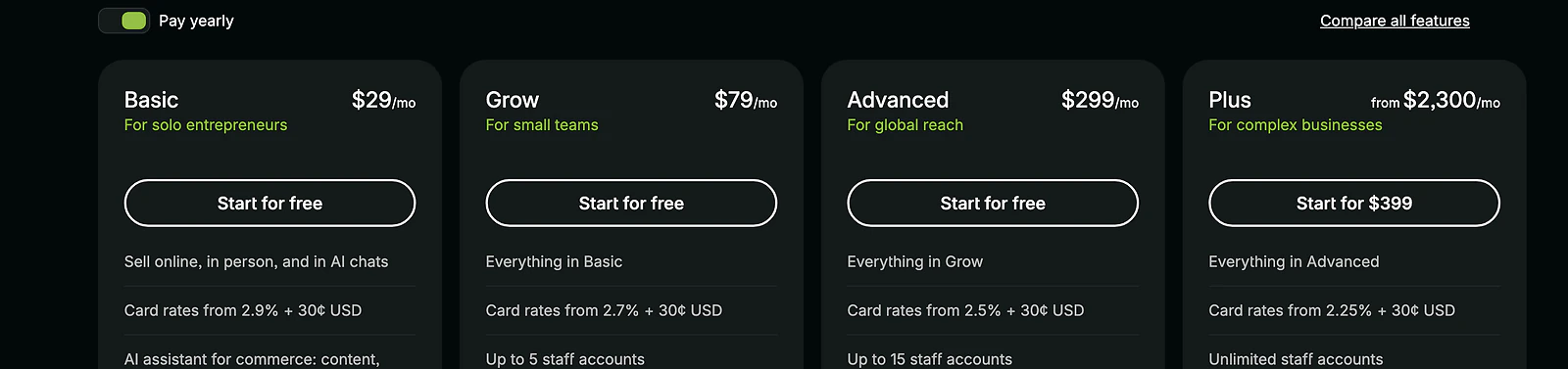
Shopify's pricing page in USD, showing Basic at 29 dollars, Grow at 79, Advanced at 299, and Plus from 2,300 per month billed yearly
Who is Shopify actually right for?
Anyone running, or seriously planning to run, a real product-based business: a growing catalog, multiple sales channels, in-person and online sales together, or serious order volume where checkout conversion and inventory accuracy directly affect revenue. It's the wrong fit, or at least expensive overkill, for a business whose site is mostly content and brand with a handful of products attached almost as an afterthought.
Does Shopify charge transaction fees?
Only if you don't use Shopify Payments. Skipping its own processor adds roughly 2 percent on Basic, 1 percent on Grow, and 0.6 percent on Advanced, on top of standard card processing. Using Shopify Payments removes that fee entirely, but it isn't available in every country or right for every existing merchant relationship, so a meaningful number of stores still pay it.
Why is my Shopify store slow?
Almost always the theme and the app stack, not the platform itself. Cold mobile scores across real stores ranged from 45 to 92 in this review, an enormous spread for one platform. A heavy theme loaded with apps drags every page load down; a lean theme with disciplined app choices holds up well. Speed on Shopify is managed, not handed to you.
Is Shopify overkill for a mostly-content site?
Often, yes. Paying a real monthly plan, a possible transaction fee, and a growing stack of app subscriptions for infrastructure built to handle serious order volume doesn't make sense for a business selling a dozen items a month. If a lighter builder is still in the running, Shopify vs Wix is worth a look.
Shopify is the right tool for a real store, and only for a real store.
If your business runs on inventory and volume, this review already made the case and you should act on it. If it's closer to content and brand with a light store attached, a direct side-by-side lives at Devani vs Shopify.