
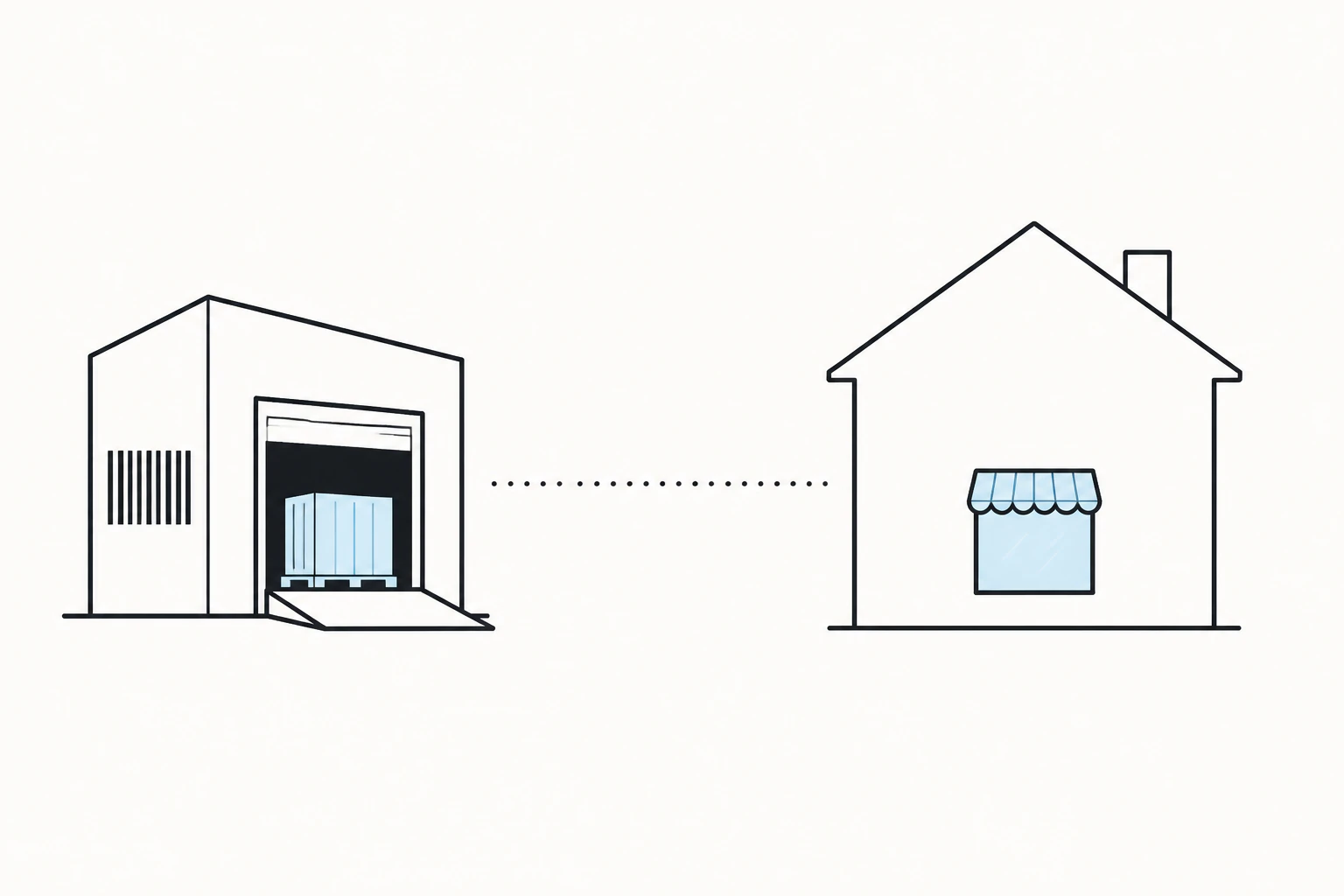
Shopify is a warehouse with a shopfront bolted on. Wix is a building with a shop near the door. Pick the wrong one and you spend a year fighting the floor plan.
Start with what the site is actually for.
If the site's main job is to move product at real volume, with inventory that scales, a checkout tuned to close the sale, and a barcode scanner behind a physical counter, you want Shopify, which was built for exactly that one job. If its main job is to be a full website (who you are, what you do, how to book you) that also sells a few things, you want Wix, where the shop is a counter near the front of a much larger building. Get that one question right and most of the rest is detail. There is a third shape in this decision too: Devani, the free open-source CMS this site runs on, which serves that Wix-shaped need (a fast, fully-built site with a light store) without the transaction fees or the app bill. Everything below is what the difference actually costs you, in dollars, features, and setup time.
I've set up stores on both of these platforms, from a single-product drop to a sizable catalog. That doesn't make me neutral, but it means the ceilings I describe below are ones I've watched both platforms hit in real, repeatable ways, not a single bad build generalized into a rule.
Shopify
Built to run a store, not a website.
- ✓ Inventory, variants, and multichannel selling built for real scale
- ✓ Mature POS for a physical counter, synced to the site in real time
- ✓ The best-converting checkout on the market
- × A stacked transaction fee if you skip Shopify Payments
- × A thin general website around the store unless you build it yourself
Wix
A whole site with a shop attached.
- ✓ Drag-anywhere editor plus an AI builder that drafts a site in minutes
- ✓ Native Bookings for appointment businesses, no Shopify equivalent
- ✓ No platform transaction fee, ever, on any plan
- × Ecommerce depth thins out past a few hundred products
- × Limited dropshipping, multichannel, and POS compared to Shopify
Devani
Wix's shape, built faster and free.
- ✓ Free and open-source, no plan to upgrade into, no per-transaction cut
- ✓ Database-free static pages, near 100/100 Lighthouse out of the box
- ✓ Connect your own ChatGPT or Claude account and edit the site by asking
- × Light store, not deep commerce: no POS hardware, no dropshipping ecosystem
The ecommerce depth is real, and it isn't close.
A lot of comparisons undersell this to make the fight look closer than it is. Shopify was built from day one to run a store, not a website that happens to have a store section, and it shows in almost every corner of the product. Inventory handles thousands of SKUs and variants without breaking a sweat. Shopify POS is a genuinely mature point-of-sale system, the kind a real retail shop with a physical register can run on, syncing inventory between the counter and the website in real time. Multichannel selling is built in: list a product once and push it to the Shop app, Amazon, TikTok, Facebook and Instagram shops, without rebuilding the listing on each one. The checkout itself converts better than almost anything else on the market, tuned over years specifically to not lose a sale at the last step. And the app store, somewhere in the neighborhood of eight to sixteen thousand apps depending who's counting that week, covers dropshipping, subscriptions, wholesale pricing, and loyalty programs. If you're running or planning to run a serious online store, Shopify's depth here is the honest answer, and I'd tell a client that directly. Our full Shopify review covers the rest of the platform in more depth.
Easier, cheaper to start, and it's a whole site.
Wix isn't the consolation prize in this comparison. For a business whose website is the main thing and the store is a smaller piece of it, it's a genuinely better fit. Here is what it actually hands you. Our full Wix review goes deeper on the platform.
A drag-anywhere editor
You can drop a section anywhere on the page, not just into a preset zone, and nudge, resize, or restack almost anything without hitting a wall. The AI site builder asks a handful of questions about your business and hands you a working draft in minutes, already laid out with your name and stock photography you can swap.
One building, not two
An about page, a services page, a blog, a contact form, and a modest shop, all built in one place, without stitching a separate ecommerce platform onto a separate marketing site. For a business where the site is the main event, that consolidation is the whole value.
Native Bookings
Wix Bookings is a real scheduling system built into the same platform: services, staff calendars, deposits, automated reminders, and a booking widget that drops onto any page. Shopify has no equivalent at all. If your business runs on appointments rather than inventory, this alone can decide it.
No platform transaction fee
Wix never takes a cut of a sale, on any plan. You pay your payment processor's standard rate and that money goes to the processor, not to Wix. Shopify layers its own fee on top of card processing unless you use Shopify Payments specifically, which is the next section.
Does Wix charge transaction fees?
No, and this is one of the clearest, most quotable differences between the two. Wix does not take a cut of any sale on any plan, ever. You still pay your processor's standard rate (typically around 2.9% plus $0.30 per transaction through the built-in options), but that money goes to the processor. Shopify's structure is more layered. Use Shopify Payments and you pay only the card-processing rate with no extra platform cut. Use a third-party gateway instead and Shopify adds its own fee on top of whatever that gateway already charges.
| Shopify plan | Card processing | Extra fee if you skip Shopify Payments |
|---|---|---|
| Basic | 2.9% + $0.30 | + 2.0% |
| Grow | 2.7% + $0.30 | + 1.0% |
| Advanced | 2.5% + $0.30 | + 0.6% |
| Wix (any plan) | ~2.9% + $0.30 to the processor | None, ever |
Higher Shopify tiers reduce both numbers, which is one of the real reasons a growing store moves up a plan. In practice most Shopify merchants just use Shopify Payments and never see the extra percentage. But if your business already runs a payment processor it needs to keep for other reasons, that stacked fee is a real cost to run the math on before you commit.
What Wix costs next to Shopify.
Wix runs four paid tiers, billed annually: Light at $17 a month with no ecommerce at all, Core at $29 a month where ecommerce actually turns on (full store, 50GB storage, five collaborator seats), Business at $39 a month adding automated tax handling and more advanced shipping rules, and Business Elite at $159 a month with unlimited storage and priority support. There's also a genuinely free plan, but it runs on a wixsite.com subdomain, carries Wix's own ads, and can't process a sale, so it's a test drive rather than a real launch option.
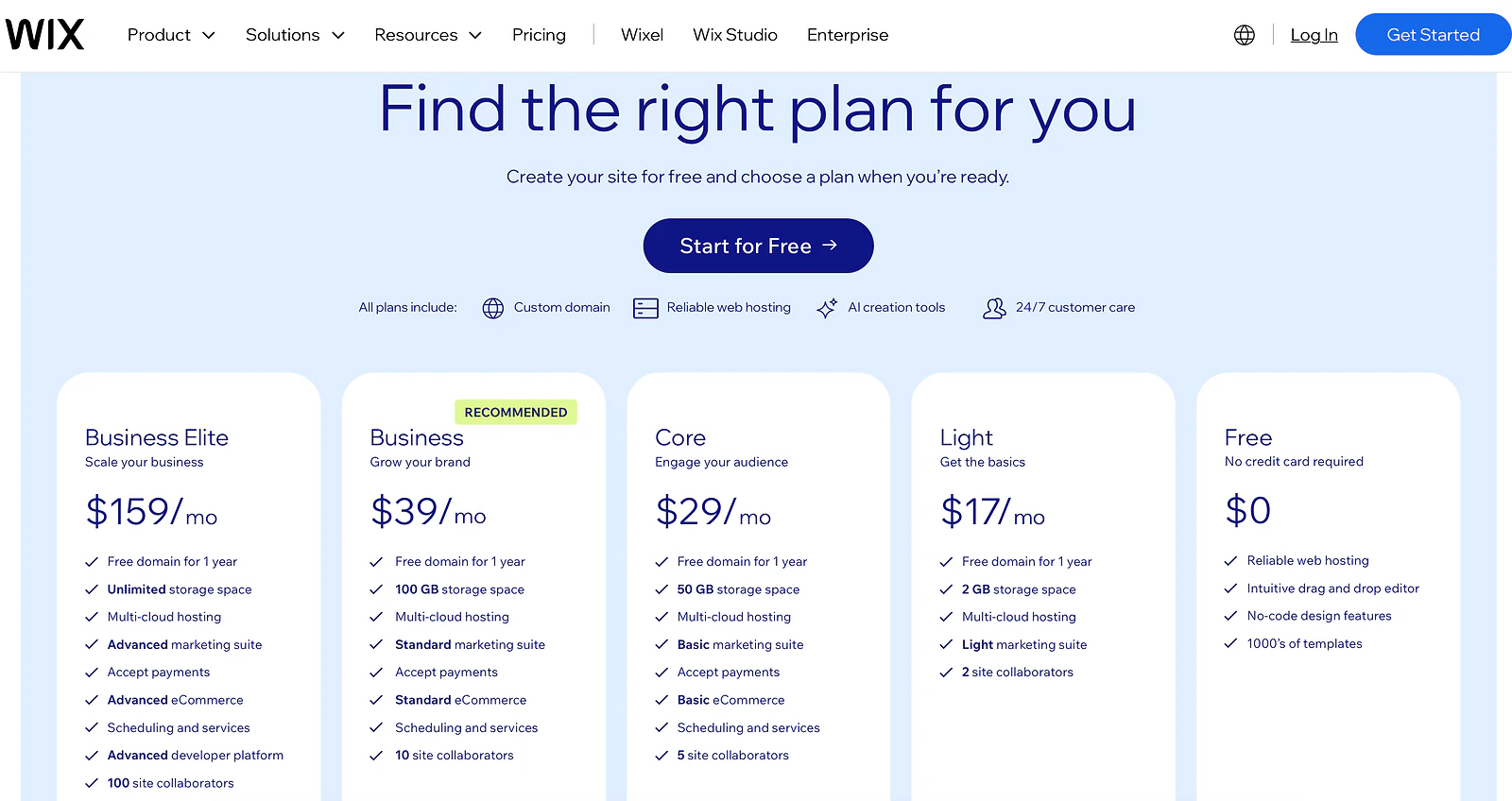
Wix's pricing page in USD, showing Free, Light at 17 dollars, Core at 29, Business at 39, and Business Elite at 159 per month billed annually
Shopify's tiers run Starter at $5 a month, really a social-selling and buy-button tool rather than a full storefront, then Basic at $29 a month billed annually (or $39 billed monthly), Grow at $79 ($105 monthly), Advanced at $299 ($399 monthly), and Plus starting around $2,300 a month for large operations that need dedicated infrastructure. Paying annually saves roughly a quarter over the monthly rate on every tier. Line the entry points up and Basic and Core both cost $29 a month, but they're not buying the same thing: Wix's $29 gets you a full website plus a real shop, Shopify's $29 gets you a store built to grow into deeper tools without much of a general website around it. Which one's cheaper depends entirely on which building you actually need.
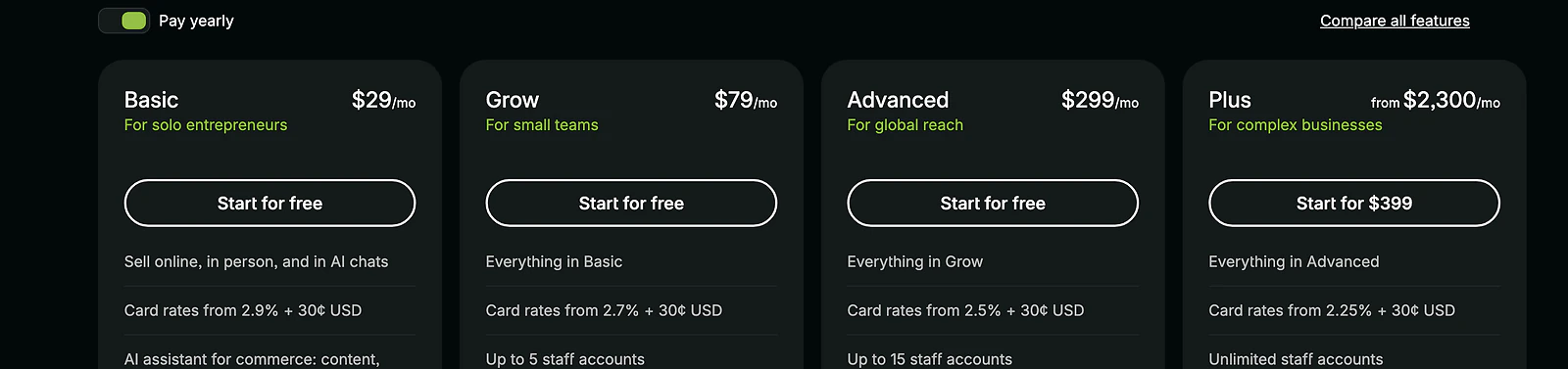
Shopify's pricing page in USD, showing Basic at 29 dollars, Grow at 79, Advanced at 299, and Plus from 2,300 per month billed yearly
Is Wix good enough for a real online store?
For a lot of stores, yes. For a store planning real scale, honestly not quite. Wix covers the actual need for a shop selling a few dozen to a few hundred products. Here is exactly where it holds and where it thins out.
- Catalog and cart: covered. A real product catalog, coupon codes, abandoned cart recovery, and inventory tracking. Wix Payments processes cards with no extra Wix cut, and setup takes an afternoon, not a week.
- Dropshipping: thin. Wix has some dropshipping apps, but the ecosystem is a fraction of Shopify's, which built an entire industry of DSers-style tooling around it over the better part of a decade.
- Multichannel: limited. Wix's sales channels are mostly the site itself plus a handful of integrations. Shopify pushes the same listing to half a dozen marketplaces without much extra setup.
- Point of sale: partial. Wix has a POS option, but it's more limited than Shopify's, US and Canada only, and the hardware runs over a thousand dollars for the full in-person setup.
For a shop with a genuinely large catalog, multiple sales channels, or a physical retail counter that needs to talk to the website in real time, Shopify is doing a job Wix wasn't built to do, and I wouldn't try to talk a client into forcing it.
Which is faster, Shopify or Wix?
Most comparisons quote a load-time number from a tool like GTmetrix and move on. I ran real PageSpeed Insights tests instead, on real stores, cold, on both desktop and mobile. Cold first-load runs are the hit a real first-time visitor gets.
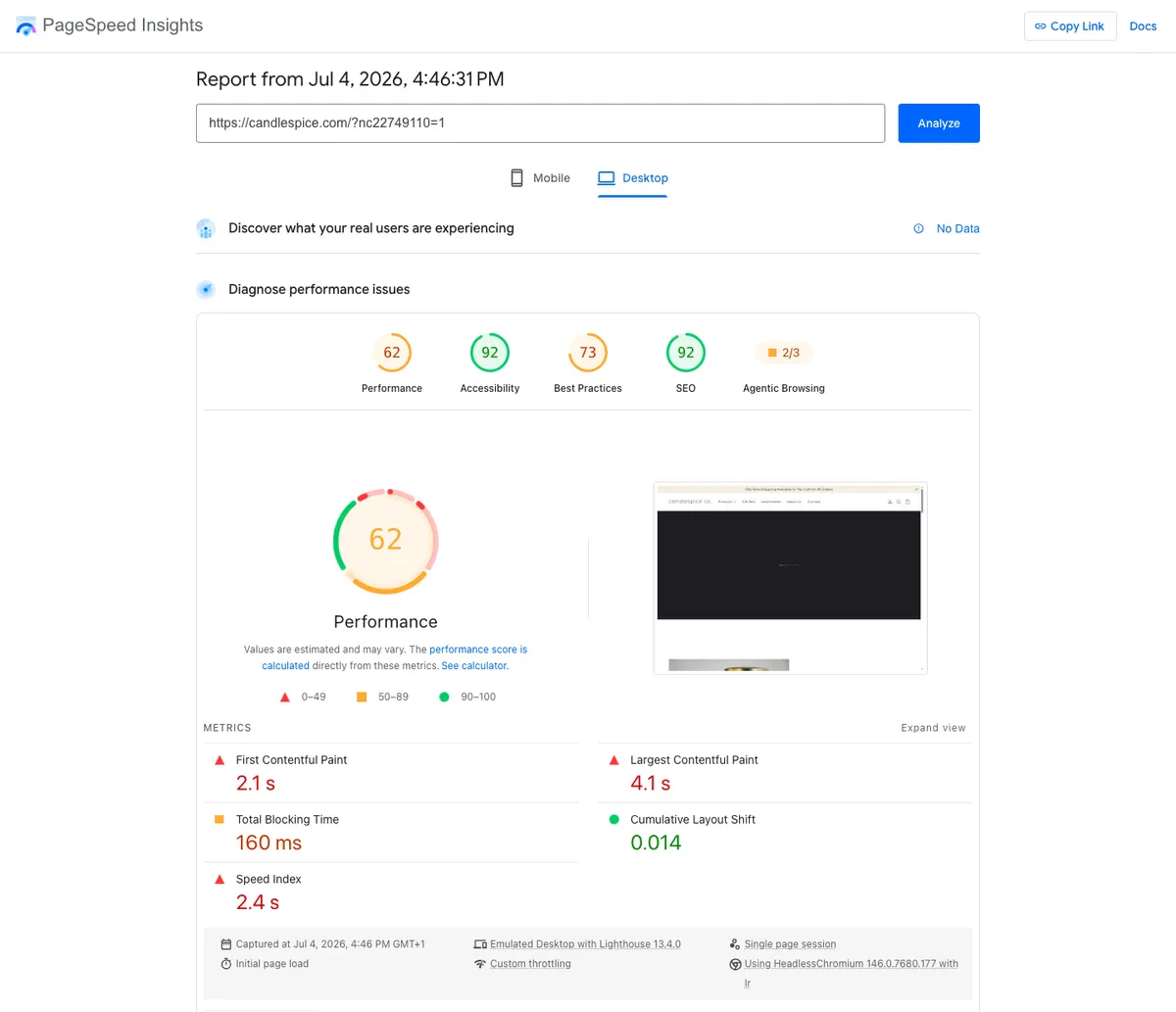
PageSpeed Insights desktop lab results for a typical Shopify candle store: 62 performance, 2.1 second first contentful paint, 4.1 second largest contentful paint
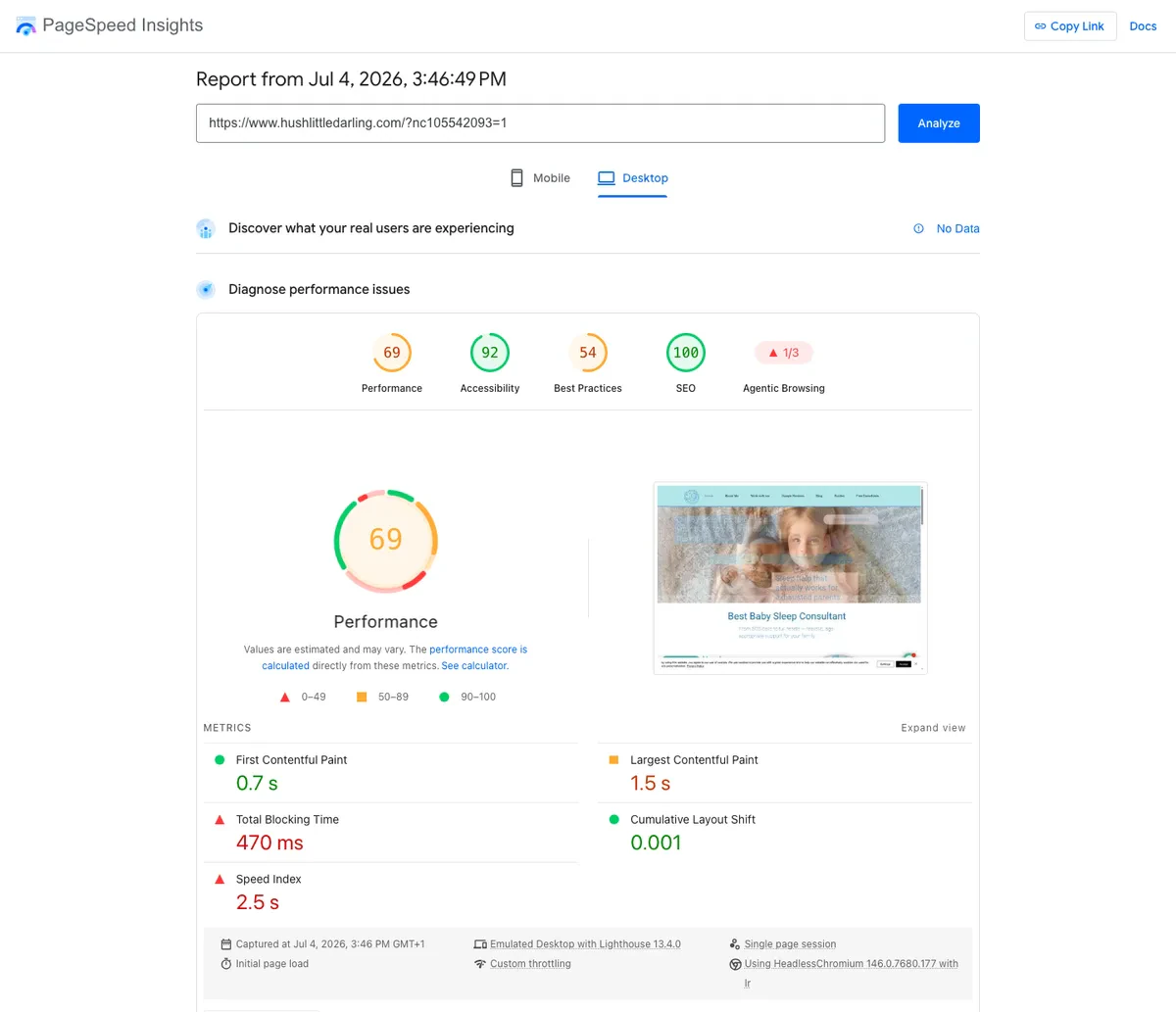
PageSpeed Insights desktop lab results for a typical Wix small business site: 69 performance, 0.7 second first contentful paint, 1.5 second largest contentful paint
The Shopify store here, a real small candle shop running a standard theme with typical product photography, scored 62 on desktop. The Wix site, a real solo-operator small business site, scored 69. Now mobile, the test that matters more, since most shopping traffic happens on a phone.
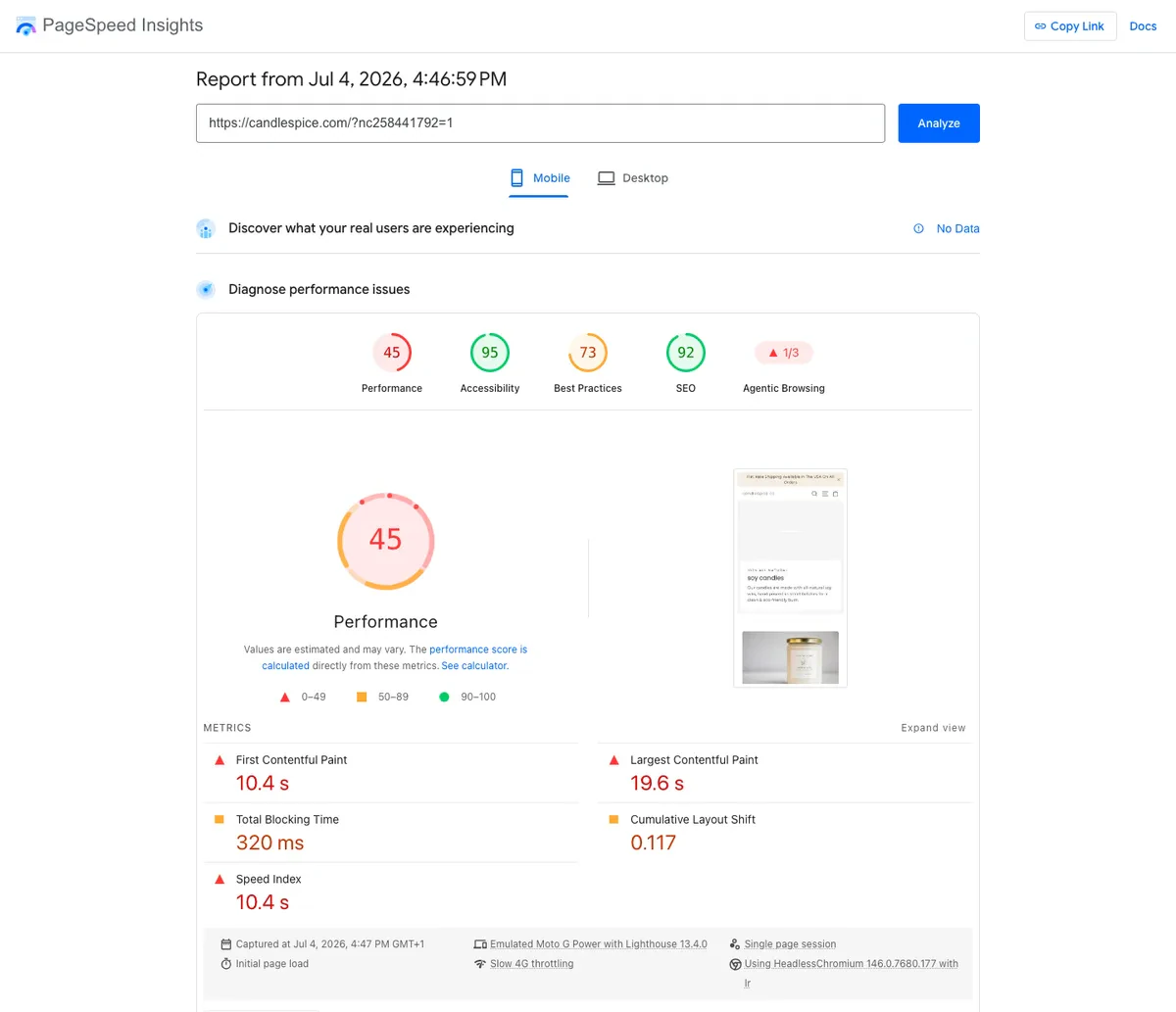
PageSpeed Insights mobile lab results for a typical Shopify candle store: 45 performance, 10.4 second first contentful paint, 19.6 second largest contentful paint
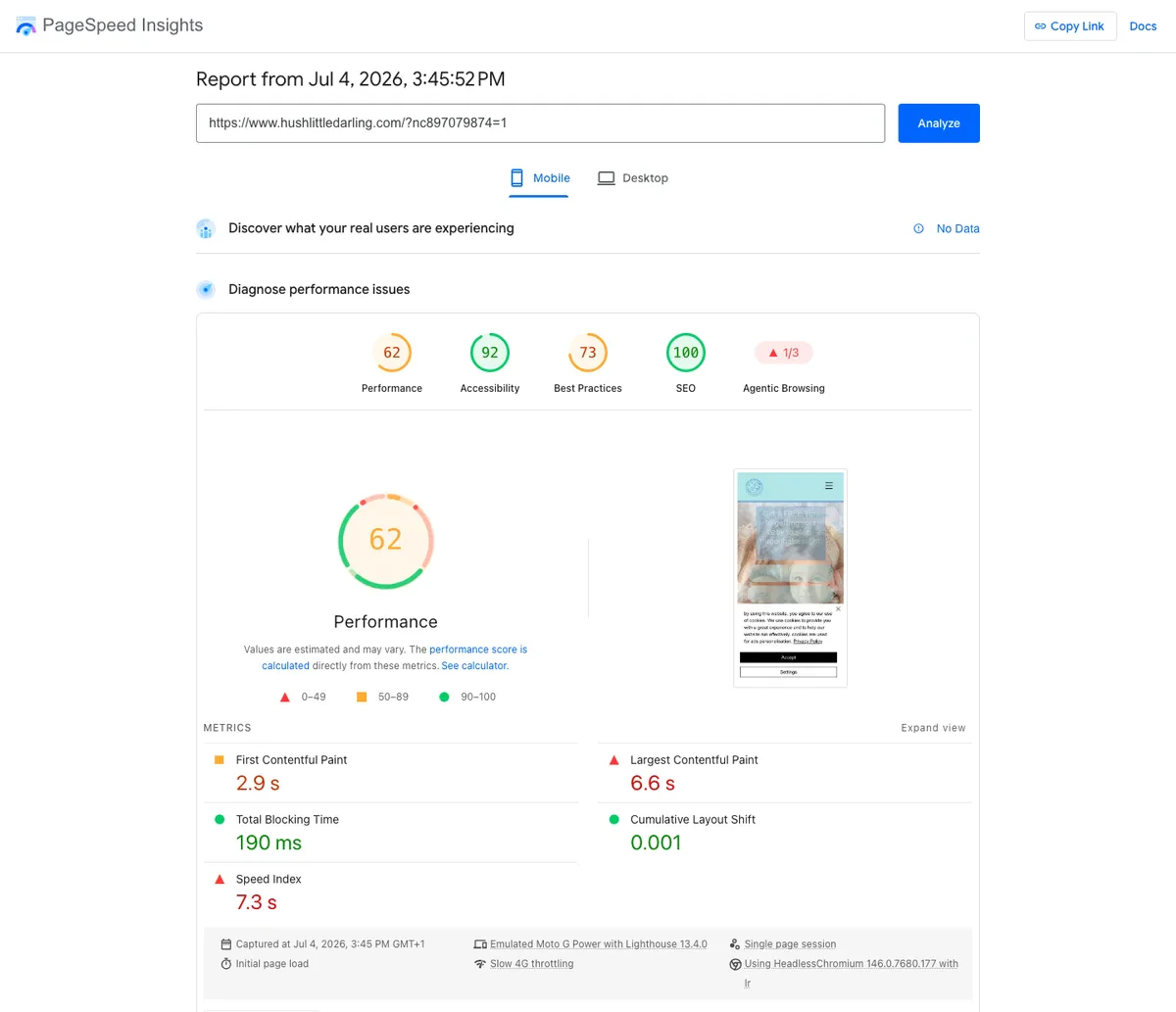
PageSpeed Insights mobile lab results for a typical Wix small business site: 62 performance, 2.9 second first contentful paint, 6.6 second largest contentful paint
On mobile the Shopify store dropped hard, to 45, with a largest contentful paint north of 19 seconds. Wix held at 62. That's a real gap, and it's worth being straight about why: Shopify speed is not one number, it's a range that swings a lot based on theme choice, how many apps are installed, and above all how heavy the product photography is. I tested three real Shopify stores for this piece and got 62/45, 92/54, and 71/81 across the three, all on the same platform, wildly different results depending on the build. The image-heavy candle store shown here is a genuinely typical example of what a small merchant ends up running, not a worst case picked to make a point, but don't read "Shopify equals 45 on mobile" as a fixed law of the platform. A lean, well-optimized Shopify build can beat this comfortably; a lot of real stores never get there because nobody goes back and compresses the product photos after launch.
Since this is the Devani blog, one more data point, then back to the two platforms you came here to compare. Devani, the separate CMS this site runs on, sits above both.
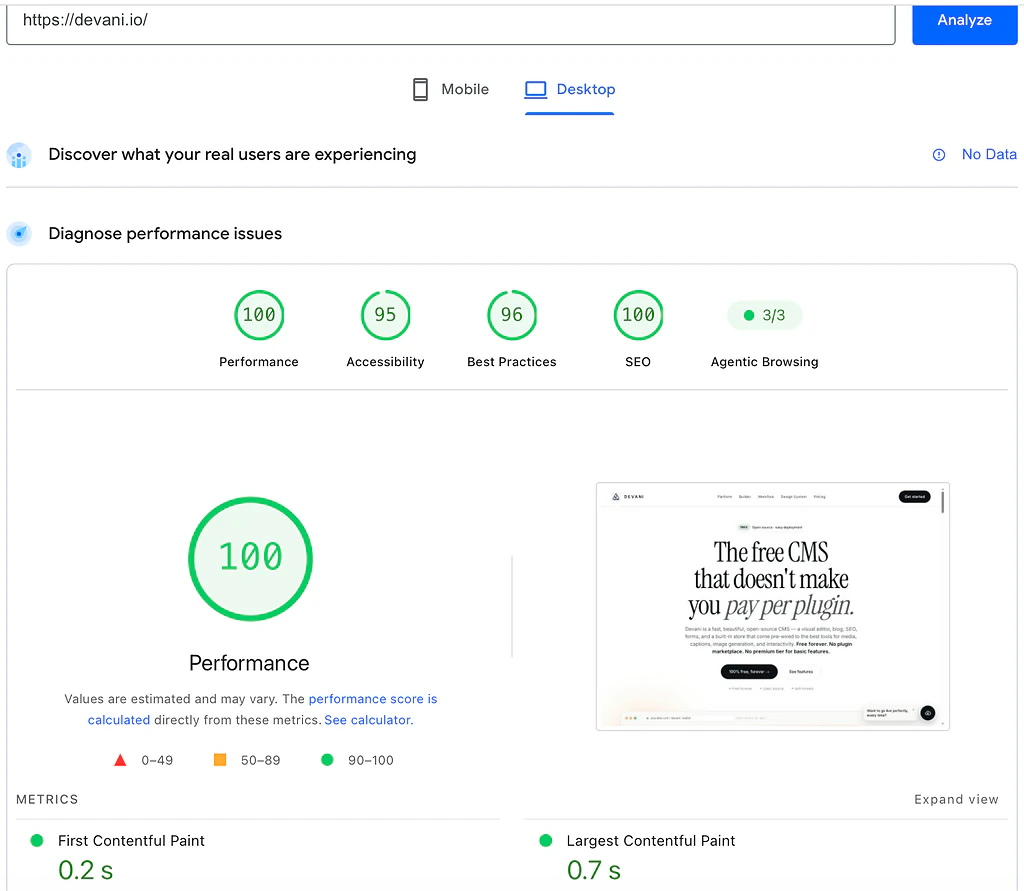
PageSpeed Insights desktop lab results for devani.io: 100 performance, 0.2 second first contentful paint, 0.7 second largest contentful paint
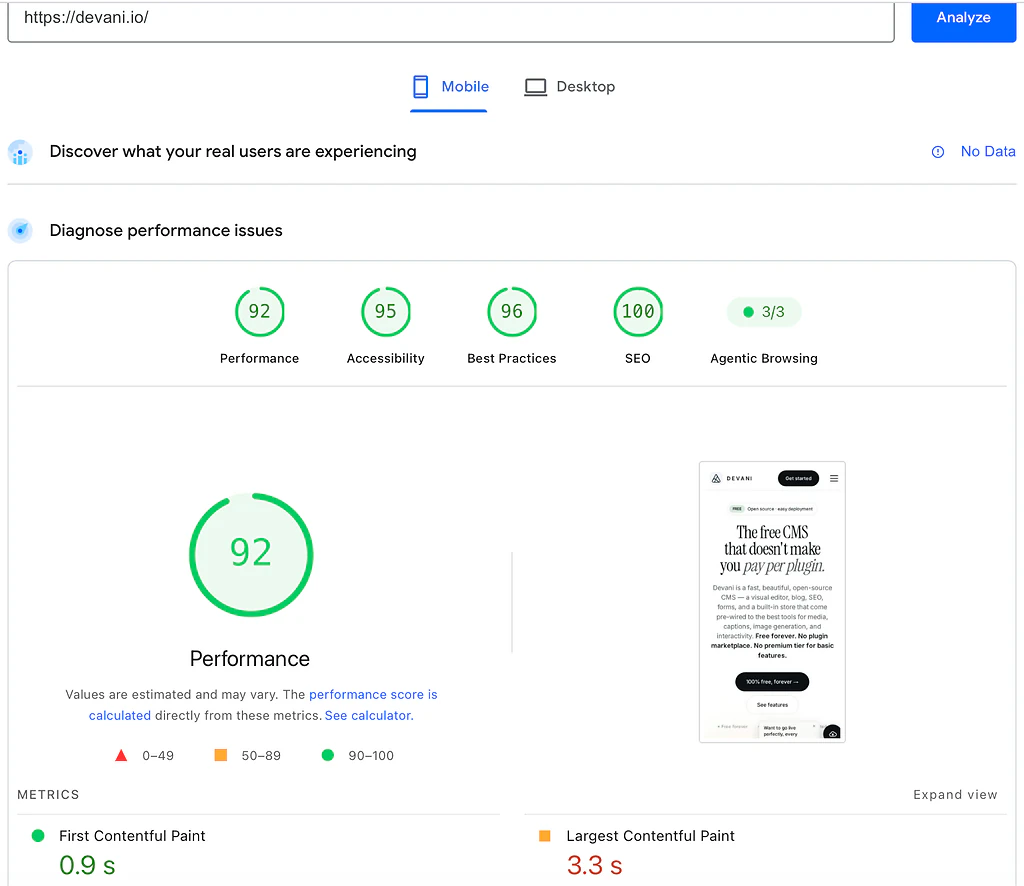
PageSpeed Insights mobile lab results for devani.io: 92 performance, 0.9 second first contentful paint, 3.3 second largest contentful paint
| Platform | Desktop | Mobile | Desktop to mobile drop |
|---|---|---|---|
| Shopify (image-heavy candle store) | 62 | 45 | 17 points |
| Wix (solo small business) | 69 | 62 | 7 points |
| Devani | 100 | 92 | 8 points |
Devani scores 100 on desktop and 92 on mobile, ahead of both, and it barely moves between the two. Being database-free is a big part of why: the site is stored as plain files with nothing to query, rather than assembled from a database on every request. But keep this in the right box: Devani is a website CMS with a light store attached, not a dedicated ecommerce platform, and this speed comparison doesn't change that. The Shopify vs Wix question stands on its own regardless: on real, cold hardware, Wix is a consistent step ahead of the Shopify range shown here, especially on mobile, and that gap is worth knowing before you assume "ecommerce platform" automatically means "fast platform." If Devani is on your shortlist too, Devani vs Wix lays out that comparison directly.
Nineteen seconds is a long time to watch a mostly blank product page on a phone, and it is exactly the wait that sends a buyer back to the search results.
Straight answers to the ones people ask next.
Which is better for SEO, Shopify or Wix?
Closer than a lot of older articles suggest, and worth correcting directly: the idea that Wix is bad for SEO is a leftover reputation from years ago, before Wix rebuilt its indexing and crawlability from the ground up. On our own PageSpeed Insights audit, Wix actually scored 100 on the SEO check against 92 for the Shopify store we tested, the opposite of the old stereotype. Both platforms generate clean, crawlable markup, support custom meta titles and descriptions, and produce an automatic sitemap without a plugin. Shopify's SEO tooling is solid and product-catalog-aware, handling structured data for product listings well out of the box. Wix's SEO panel walks a beginner through a setup checklist item by item. Neither is a real handicap for a small or mid-sized store; the bigger lever for either is the content and product descriptions you actually write, not the platform underneath.
What about a service business instead of a product business?
This is where Wix has a genuine, specific advantage with nothing on the Shopify side to answer it. Wix Bookings is a native scheduling system built into the same platform: services, staff calendars, deposits, automated reminders, and a booking widget that drops onto any page like any other Wix element. A massage therapist, a tutor, a contractor who takes consultation appointments, none of these are selling a shippable product, and Shopify has no real answer; you'd be bolting a third-party scheduling app onto a platform built around a shopping cart, which is exactly backward for what that business needs. If your business runs on appointments rather than inventory, this isn't a close call. Wix, or a general-purpose site builder like it, is doing the job Shopify was never built to do.
How do templates and actually building the site compare?
Wix's template library is enormous, north of a thousand free designs across every business type, and the drag-anywhere editor means you can nudge, resize, or restack almost anything without hitting a wall. Shopify's theme library is smaller and more structured. Free themes number a couple dozen, and most stores end up buying a paid one, typically $150 to $350 as a one-time cost, because a store's theme does real commercial work (product grids, filters, upsells) a general-purpose template was never built around. Shopify's editor is also more constrained: you arrange pre-built sections within a theme's structure rather than dragging anything anywhere, because the system optimizes for a store that behaves predictably under real traffic. Neither approach is wrong, they're optimizing for different things. If Wix's ceiling is the sticking point, our Wix alternatives roundup covers what else is worth weighing.
How hard is it to switch between Shopify and Wix?
Harder than either platform's marketing suggests, in both directions. Shopify has a genuine store export: products, customers, and orders come out in CSV formats another platform, including Wix, can import in a recognizable shape. What doesn't come over cleanly is your theme, your app configuration, and anything custom built with Shopify's Liquid templating, all of which has to be rebuilt by hand. Wix to Shopify is similar in reverse: product data imports reasonably well, but page layouts, any Wix app you were using, and your non-store content need rebuilding from scratch, because Shopify isn't set up to be a general website the way Wix is. I've run this migration both directions for clients, and it's never the weekend project people expect. Budget real days, and preserve your URLs carefully so search rankings don't die with the old platform.
The third building that skips the app bill.
Add up what Shopify and Wix actually charge past the plan price and a pattern shows up. Shopify's transaction-fee stack if you skip Shopify Payments is spelled out above, and both platforms tend to grow an app bill over time, an extra $10 or $20 a month here for subscriptions, upsells, or better email capture, stacking as the store grows. Wix already beats Shopify on the transaction-fee half of that math. I build Devani, so weigh this next part accordingly, but it skips the other half too: there's no app or plugin marketplace to shop in at all, because there's no plugin stack to keep patched in the first place. Devani is free and open source, no monthly software fee, no per-transaction cut on any plan. Run it on your own hosting, about $5 a month through a one-command installer, or Devani's own managed hosting, free tier included, if you'd rather not run a server, with opt-in updates on your own schedule instead of either platform's ongoing upkeep.
Where Devani actually earns its place is the same shape of need Wix serves, a real, fast, fully-built website with a light store attached, resolved differently: you connect your own ChatGPT or Claude account through MCP, using an existing subscription with no API keys, and it makes real edits to your site's actual content and layout on request, instead of a drag-and-drop session or an app you had to find, install, and pay for first. Because Devani's pages are plain HTML, those edits land in the visual editor with every change snapshotted and one click from rollback.
What Devani doesn't have is either platform's years of runway: no app marketplace close to Shopify's for deep ecommerce features, no dropshipping ecosystem, no point-of-sale hardware, and a newer platform without a decade of freelancer familiarity behind it. If your business is the store, pick Shopify, full stop. If your business is a site that also sells something, Wix and Devani are both playing that same game, and Devani plays it without the app bill.
Not a warehouse, just a good building with a small shop in it?
Shopify for a serious, scaling store with real inventory and multiple channels. Wix for a business that needs a whole site with a shop attached and would rather not pay a transaction fee. If your real answer landed closer to "a fast site with a light store, and no creeping app bill," that's worth a look at Devani before you commit. It's free, so there's nothing to lose by trying it.