

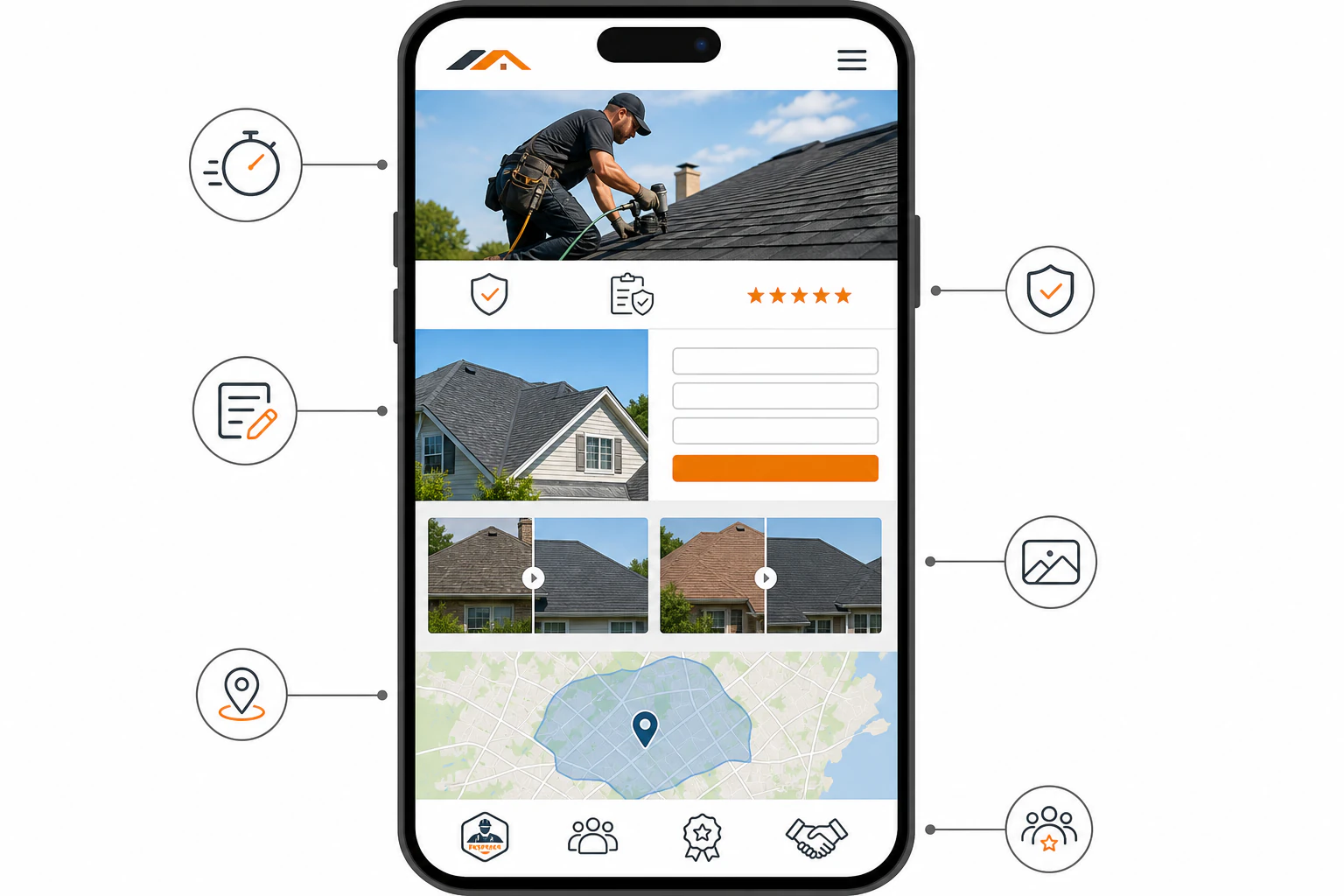
The best platform is whichever one gets a mobile visitor to a quote form or a phone call in under three seconds.
It has to show real finished work instead of stock photos, and it can't need the owner to touch a dashboard once it's live. That rules out more options than you'd think, and it doesn't point to one single winner. WordPress, Squarespace, Wix, the GoDaddy-style all-in-ones, contractor-specific marketing vendors, and lead-rental marketplaces all solve pieces of this differently, and Devani sits in this list too. I've built or maintained sites on most of them for trades businesses over the years. Here is the honest breakdown, and where Devani fits into it.
Six things a contractor site lives or dies on.
Speed on a phone
Someone standing in their driveway after a hailstorm is on a phone with a mediocre connection. If the site takes six seconds to show anything, they call the next name on the list. Contractor sites lose leads to load time more than almost any other vertical.
Lead capture that isn't a maze
A quote form, a click-to-call number that dials on tap, and a short intake: project type, rough size, timeline, photos. Long forms with ten fields kill conversions. Short forms with the right fields don't.
A real project gallery
Before-and-after photos of actual roofs and additions, not a hard hat and a clipboard. Pair each job with a line of context: what was replaced, what it took, how long. The gallery does the trust work a portfolio does for a designer.
Service-area local SEO
Most contractors serve a radius, not a country. The site has to rank for "[service] [town]" across every town in it, and show in the Google local pack tied to a verified Business Profile. A page per town, with real local content, beats one generic service-area page.
Trust signals up front
License numbers, insurance, manufacturer certifications, warranty terms, reviews. Homeowners hiring someone to work on their roof are more risk-averse than almost any purchase this size. The site has to answer "can I trust this person" before anything else.
Low ongoing fuss
The owner is running crews and bidding jobs. The platform can't require a weekly login to install updates or fix a broken plugin. That work either doesn't happen, or it happens instead of something that makes money.
The gallery-as-portfolio dynamic is the same one that shapes a landscaping company's site, and the trust-first calculus is the same one behind a law firm's site, with a license number standing in for a bar admission. Contractor sites sit at the intersection of both.
On a phone, in a driveway, on bad signal, the page that loads is the page that gets the call.
This is why mobile speed is the one number I weight above the rest for trades sites, and it is where Devani's database-free, plugin-free architecture lands around 100 desktop and 92 mobile in real testing. The homeowner on bad signal is exactly the reader you are optimizing for.
Four general-purpose builders, then where Devani lands.
WordPress
Deepest page-generation tooling at volume. Someone has to maintain it.
- ✓ Forty service-area pages, branching quote forms, review schema, all doable
- × Cold Lighthouse around 63 desktop / 47 mobile; plugins and updates are a constant tradeoff
Squarespace
Best when the finished work sells itself. High-end remodeler territory.
- ✓ Genuinely beautiful templates, around 89 / 59 cold, owner can swap photos solo
- × Local-SEO granularity and branching forms are thinner than WordPress
Wix
Guided setup with built-in quote and booking forms.
- ✓ Native intake forms and click-to-call, AI-assisted setup, least friction
- × Around 69 / 62 cold and it worsens as apps pile on; weaker for multi-town SEO
GoDaddy-style bundlers
One bill, almost no decisions. For the owner who wants to not think about it.
- ✓ Domain, site, and basic marketing in one bundle, minimal setup
- × Low ceiling; generic templates, limited branching forms and service-area structure
Devani
Fast, low-maintenance, updatable from a phone between jobs.
- ✓ Around 100 / 92 Lighthouse, free and open-source, opt-in updates, native AI edits to content and layout
- × Young ecosystem, no native field-service CRM integrations yet
"Native" is the right word, not "exclusive." You connect your own ChatGPT or Claude account and it edits the live site. WordPress has the same idea now through WordPress.com's MCP integration and the Vibe AI plugin, with one real limit: it only works well in WordPress's own block editor. On a site built with Divi or Elementor (a large share of the contractor sites out there), the AI can't reliably write the shortcodes those builders depend on, or it burns through context trying. The WordPress MCP gives you AI-written content plus the standard HTML editor. It does not give you a builder. Devani's pages are plain HTML that Claude and ChatGPT write easily, and every edit lands in the visual editor where you can finish it by hand. That is the real line between native and bolted-on: on Devani the assistant works inside the builder, on WordPress it works alongside it.
Contractor vendors and lead marketplaces play a different game.
Both show up in every "best website platform for contractors" search, and neither is really a website platform. Worth being direct about both.
Contractor-specific vendors. Companies like JobNimbus and a handful of trade-focused agencies bundle a website with a CRM, job quoting, and marketing built around storm-season and insurance-cycle demand. The pitch is real and sometimes earned: they understand how roofing leads behave after a hailstorm, and the CRM integration means a site lead drops straight into the system the office uses to schedule and invoice. The tradeoff is cost and lock-in, priced well above a general platform, often with no public price list, and switching away means untangling the site from the CRM it feeds. Defensible if you are already committed to that CRM. Often more platform and cost than the job actually needs.
Lead-generation marketplaces. HomeAdvisor and Angi are the names homeowners recognize. These are not a website platform at all. You pay to appear in front of homeowners requesting quotes, bidding against other contractors for the same lead, often paying whether or not the job closes. It works as a supplemental source for a new business with no reviews yet.
It is rented attention, not an owned asset. Stop paying and the leads stop.
A real site with a Google Business Profile, actual reviews, and ranking service-area pages builds equity that compounds for free every month after it's built. Treat a lead marketplace as a short-term supplement to a real site, not a replacement for one.
Cold Lighthouse, four platforms.
Cold means a real first visit with no cache warmed up, which is what a homeowner on a fresh search actually gets. Mobile is the column that decides leads for this vertical.
| Platform | Desktop | Mobile | What it means for a trades site |
|---|---|---|---|
| Devani | ~100 | ~92 | Fast by default, no plugin stack to tune |
| Squarespace | ~89 | ~59 | Solid for a hosted builder; design over speed |
| Wix | ~69 | ~62 | Workable, worsens as apps are added |
| WordPress (typical) | ~63 | ~47 | Features and speed are a constant tradeoff |
Devani's number is the starting point, not the result of a performance project. The WordPress figure is a range in practice, not a single number: a lean build on strong hosting can do better, but most contractor sites I've measured sit here because the useful plugin stack (forms, galleries, local SEO) costs load time.
Which one depends on the job.
I need dozens of service-area pages that actually rank.
If the question is ranking, Devani wins it plainly: clean semantic markup, per-page meta, schema, and sitemaps built in, and speed that Core Web Vitals reward, all without an SEO plugin. What WordPress genuinely still has is page-generation tooling at volume. If you need to programmatically stamp out forty town pages from a template, its plugin ecosystem does that today and Devani makes you build each page (or have your AI assistant build them). That tooling is WordPress's real edge here, not the rankings themselves.
The finished work looks great in photos and the owner wants to update it themselves.
This is Devani's strongest case. The owner opens the visual editor or just asks their own ChatGPT or Claude to swap the photos and rewrite the caption, and the media library converts uploads to WebP automatically, so photos straight off a phone don't slow the site down. Squarespace deserves a nod for template polish out of the box, but "the owner updates it themselves" is the exact job edit-by-asking was built for.
I need something live this week, full stop.
Devani, and it is not close. On the managed free tier a site is live in under a minute, or one command stands it up on your own server, and from there your AI assistant builds pages while you feed it photos and job details. Wix deserves credit for a guided setup with native quote and booking forms, but it is not faster than under a minute, and it weakens as you grow; the Wix review covers that across business types.
My business already runs on a specific field-service CRM.
A contractor-specific vendor wired into that ecosystem may be worth the higher cost. The CRM integration is the real value, not the website itself.
None of those. I want fast, low-maintenance, well-ranked, and phone-updatable.
That is the case Devani is built for. Fast by default, no plugin treadmill, native AI edits from a phone between jobs. The honest limit is ecosystem maturity: no native CRM integrations yet. Worth stacking against the fuller cost picture across platforms.
Fast where it matters. Update it from the truck.
A contractor-style site that loads on a phone in bad signal and gets new photos added between jobs. Free and open-source, or let managed hosting run the server.